
Traffic does not automatically create customers
You can increase website traffic every month and still see little change in enquiries or sales. More visitors only matter when the right people reach the right pages, understand your offer, trust your business, and have a clear reason to take action.
That gap between visibility and revenue is where many businesses get stuck.
Why increase website traffic is not enough
Traffic is an acquisition metric. Leads are a business outcome.
A website can attract thousands of visitors from search engines, social media, referrals, or paid campaigns without generating enough qualified enquiries. The problem is not always SEO. Sometimes the website is doing its job by attracting visitors, but the rest of the customer journey is breaking down.
For example, imagine a local service company ranking for several informational searches. Organic sessions are increasing, but most visitors are reading blog posts and leaving without contacting the business.
The SEO campaign may be generating traffic successfully.
The website may simply be failing to turn that traffic into opportunities.
Before trying to drive even more visitors, look at:
- Where the traffic is coming from
- Which keywords are generating visits
- Whether those keywords reflect buying intent
- Which landing pages receive the most traffic
- How visitors behave on those pages
- Whether calls to action are clear
- Whether the website communicates trust quickly
- Whether the next step is obvious
This is why qualified website traffic matters more than raw session numbers.
1. You may be attracting the wrong type of traffic
Not every visitor has commercial intent.
Someone searching for “how much does SEO cost” may be researching. Someone searching for “SEO agency London Ontario” is much closer to contacting a provider.
Both searches can generate organic traffic, but they represent different stages of the buying journey.
If your SEO strategy focuses heavily on high-volume informational keywords, traffic can rise while lead volume remains flat.
Look at your search queries in Google Search Console and separate them into categories such as:
- Informational: Users are looking for answers or education.
- Commercial investigation: Users are comparing solutions or providers.
- Transactional: Users are ready to take action.
- Navigational: Users are looking for a specific business or website.
A healthy SEO strategy can target all four, but a lead-generation website needs sufficient commercial and transactional visibility.
The goal is not simply to increase website traffic. It is to attract visitors who have a realistic reason to become customers.
2. Your landing page may not match search intent
Getting a visitor onto your website is only the first step.
The next question is whether the page gives them exactly what they expected.
Suppose someone searches for “local SEO services for small business” and lands on a generic digital marketing page. The visitor now has to figure out whether your company actually provides the service they were looking for.
That extra uncertainty creates friction.
A strong landing page should make three things clear almost immediately:
- What service you provide
- Who the service is for
- What the visitor should do next
The headline, supporting copy, proof points and CTA should work together rather than making the visitor hunt for information.
This is also where your SEO services can support conversion-focused search visibility by aligning keyword targeting with dedicated service pages and relevant user intent.
3. Your website may have weak or unclear calls to action
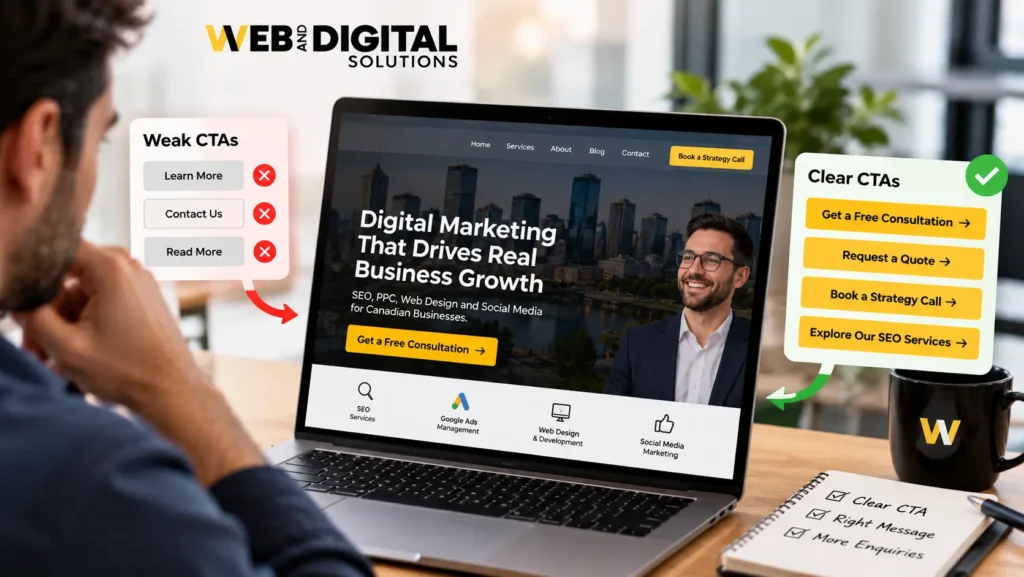
A surprisingly common problem is making the visitor decide what to do next.
“Learn More” is easy to ignore.
“Contact Us” can be vague.
“Book a Strategy Call” or “Request a Free Consultation” gives the visitor a much clearer action.
Your CTA should reflect the stage of the visitor.
For example:
- Service page: “Get a Free Consultation”
- High-intent landing page: “Request a Quote”
- Consultation page: “Book a Strategy Call”
- Educational blog: “Explore Our SEO Services”
Do not assume visitors will navigate through your website on their own.
If generating enquiries is the goal, the path to enquiry should be obvious.
4. Your website may not provide enough trust signals
Visitors do not only evaluate what you sell. They evaluate whether they can trust you to deliver it.
This becomes particularly important for businesses selling professional services, where a visitor may be deciding whether to spend hundreds or thousands of dollars.
Useful trust signals can include:
- Client testimonials
- Case studies
- Measurable results
- Industry experience
- Relevant certifications
- Client logos, where appropriate
- Clear contact information
- Detailed service explanations
- Author information for expert content
- Transparent business information
For local businesses, location-specific credibility can also matter.
A generic statement such as “We help businesses grow” is easy for competitors to copy. Specific evidence is harder to ignore.
Instead of simply saying you have experience, explain what you have done, who you have helped, and what changed as a result.
5. Slow pages can quietly reduce conversions
Website speed is often discussed as an SEO issue, but it is also a conversion issue.
A visitor who clicks a search result and waits for a page to load is already experiencing friction before reading a single sentence.
This is especially important on mobile devices, where users may be dealing with slower connections or limited screen space.
Review:
- Core Web Vitals
- Mobile page performance
- Image sizes
- Unnecessary scripts
- Third-party tools
- Large video files
- Redirect chains
- Server response times
Speed alone will not fix a poor website. But if your traffic is increasing and visitors are dropping before engaging with your pages, technical performance deserves attention.
6. The website may be asking for too much too soon
Not every visitor is ready to complete a long form or schedule a sales call.
A visitor who has just discovered your company may need more information before taking a high-commitment action.
This is where conversion paths become important.
For example, a service page could provide:
Primary CTA: Book a Strategy Call
Supporting conversion options:
- View a case study
- Read related resources
- Request more information
- Explore another relevant service
The objective is not to create dozens of competing CTAs. It is to provide an appropriate next step based on user intent.
7. Your traffic may be landing on pages that were never designed to convert
Blog posts are excellent for attracting organic visitors, but they are not automatically lead-generation pages.
A visitor may land on an article, find the answer they need, and leave.
That does not mean the article failed.
The opportunity is to create a logical connection between the information they consumed and the service that can solve the underlying problem.
For example, an article about increasing website traffic could naturally introduce website conversion optimization, SEO services, website development services, or lead generation marketing where relevant.
Internal links should help visitors move deeper into the site rather than simply adding links for SEO purposes.
8. Conversion problems can hide behind good SEO numbers
This is where reporting needs to go beyond rankings and organic sessions.
If traffic is increasing but leads are not, compare the following metrics:
| Metric | What it can tell you |
| Organic sessions | Whether search visibility is generating visits |
| Search queries | Whether traffic matches business intent |
| Landing pages | Where visitors enter the website |
| Engagement | Whether visitors interact with the page |
| Conversion rate | Whether visitors take desired actions |
| Form submissions | Whether enquiries are being generated |
| Calls | Whether high-intent visitors are contacting you |
| Qualified leads | Whether traffic is commercially valuable |
The important distinction is between traffic growth and business growth.
A website receiving 10,000 poorly matched visitors is not necessarily more valuable than one receiving 2,000 highly relevant visitors that generate qualified enquiries.
A practical way to diagnose website traffic but no leads
If your website is receiving traffic but enquiries are disappointing, work through the funnel in order.
Step 1: Check traffic quality
Identify the keywords, channels and pages producing your visitors.
Ask whether those visitors are realistically looking for what you sell.
Step 2: Check landing-page relevance
Compare the search query with the page visitors reach.
If there is a mismatch, improve the page targeting or create a more appropriate landing page.
Step 3: Review the first screen
Can someone understand your offer, audience and value within a few seconds?
If not, your messaging probably needs work.
Step 4: Review conversion paths
Check whether visitors can easily call, submit a form, request a quote, book a consultation or take another meaningful action.
Step 5: Add proof
Strengthen testimonials, case studies, results, credentials and other evidence that reduces uncertainty.
Step 6: Test rather than guess
Use analytics, Search Console, heatmaps, recordings and conversion data to identify where users are struggling.
Then make focused changes and measure the outcome.
Traffic and conversion need to work together
The strongest growth strategy does not treat SEO and conversion optimization as separate activities.
SEO brings relevant people to the website.
Content helps answer their questions.
Landing pages connect their needs with your services.
UX makes the journey easier.
Trust signals reduce uncertainty.
CTAs encourage the next step.
Analytics show what is working and what needs improvement.
That is how increase website traffic becomes more than a visibility objective. It becomes part of a larger lead-generation system.
Your website development services can also play an important role when technical limitations, page structure, mobile experience or conversion barriers are preventing visitors from taking action.
Turn More of the Traffic You Already Have into Opportunities
If your analytics show rising traffic but your sales pipeline has not moved with it, the answer may not be another round of keyword expansion.
At Web & Digital Solutions, we look beyond traffic numbers to understand what happens after visitors arrive. Find the pages attracting visitors. Identify the queries behind those visits. Compare search intent with page content. Review CTAs, trust signals, speed and user experience. Then improve the parts of the journey that are preventing visitors from becoming enquiries.
That approach makes lead generation marketing much more closely connected to SEO performance. Instead of treating traffic, website performance and conversions as separate goals, Web & Digital Solutions focuses on how they work together to support measurable business growth.
The goal is not simply to bring more people through the door. It is to make sure the right people can quickly understand your offer, trust your business and take the next step.
Frequently Asked Questions
Why is my website traffic increasing but leads are decreasing?
Traffic can increase while leads decline when the additional visitors have lower commercial intent, landing pages do not match search intent, or conversion paths are unclear. Traffic quality and conversion performance should be analysed together.
How can I increase website traffic and generate more leads?
Focus on attracting relevant search traffic while improving landing pages, calls to action, trust signals, website speed and conversion paths. SEO and conversion optimization should work together rather than being treated as separate activities.
What is qualified website traffic?
Qualified website traffic consists of visitors who are relevant to your business and have a realistic interest in your products or services. A smaller amount of highly relevant traffic can generate more business than a large volume of poorly matched visitors.
How do I know if my website has a conversion problem?
Review landing-page performance, engagement, conversion rates, form submissions, calls and user behaviour. If relevant visitors are reaching important pages but rarely taking the desired action, the website may have a conversion or user-experience problem.
Should I focus on SEO or website conversion optimization?
Both can be important. SEO helps attract relevant visitors, while conversion optimization helps turn those visitors into enquiries or customers. If traffic is already growing but leads are not, improving the conversion journey may deserve greater attention.