
Google Ads can help Canadian businesses reach people who are actively searching for their products or services. But before launching a campaign, one important question needs to be answered: how much should you spend, and what can that budget realistically achieve?
The answer depends on several factors, including your industry, target location, keyword competition, advertising objectives, landing page quality, and ability to convert clicks into enquiries or sales. Two businesses spending the same amount can experience very different results because their audiences, offers, and conversion rates are not the same.
Understanding Google Ads cost in Canada means looking beyond the daily budget. You also need to account for cost per click (CPC), campaign management fees, landing page improvements, conversion tracking, and the cost of acquiring a qualified lead.
This guide explains how Google Ads pricing works, how to estimate a starting budget, and how to evaluate whether your advertising spend is supporting your business goals.
How Much Do Google Ads Cost in Canada?
There is no single fixed price for Google Ads in Canada. The platform generally uses an auction system in which advertisers compete to show ads for relevant searches. Your actual costs depend on the auctions you enter, your targeting, competition, ad quality, and other factors.
For small businesses, the most useful approach is to calculate a budget based on the number of relevant clicks you want to attract and the cost your business can reasonably afford to acquire a customer.
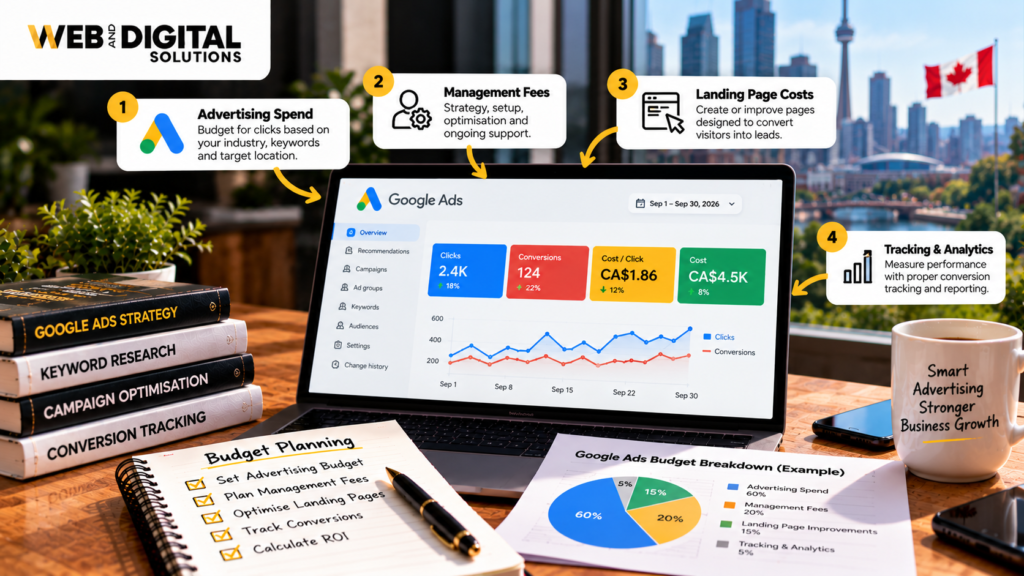
Your total investment may include:
- Advertising spend: Money paid to Google for clicks or other campaign interactions, depending on the campaign and bidding strategy.
- Management fees: Payment to an agency or specialist for strategy, setup, optimisation, and reporting.
- Landing page costs: Expenses for creating or improving pages designed to turn visitors into leads or customers.
- Tracking and analytics: Costs associated with implementing, maintaining, or improving measurement systems where applicable.
These costs should be evaluated separately so you can understand how much goes directly to advertising and how much supports campaign performance.
1. Understand the Difference Between Ad Spend and Management Fees
One of the most common budgeting mistakes is treating the advertising budget and the campaign management fee as the same expense.
They are different parts of your total marketing investment.
Google Ads advertising spend
Advertising spend is the amount allocated to your campaigns. Google uses this budget to participate in eligible ad auctions and deliver ads according to your campaign settings and bidding strategy.
For example, if you allocate CAD $1,000 per month to advertising, that is your planned media budget—not necessarily the full cost of running the campaign.
Google Ads management fees
Management fees cover the professional work required to plan and manage your campaigns. Depending on the agreement, this may include:
- Keyword research and campaign structure.
- Search term analysis and negative keyword management.
- Ad copy development and testing.
- Audience, location, and device targeting.
- Bid and budget optimisation.
- Conversion tracking checks.
- Landing page recommendations.
- Performance reporting and strategic reviews.
Agencies may charge a fixed monthly fee, a percentage of advertising spend, a one-time setup fee, or a combination of these arrangements.
Before hiring a provider, confirm exactly what is included, who owns the advertising account, whether landing page work is covered, and whether conversion tracking is part of the service.
Your total monthly investment is the combination of advertising spend, management fees, and any additional costs required to run the campaign.
2. What Determines Google Ads Cost Per Click in Canada?
Cost per click, commonly called CPC, is the amount paid for an individual click on an ad. Your average CPC is calculated by dividing the total click cost by the number of clicks received.
Several factors can influence how much you pay.
Keyword competition
Commercial searches can attract multiple advertisers competing for the same audience. The number and strength of competing advertisers can affect auction costs.
For example, a keyword related to an urgent professional service may attract a different level of competition from a broad informational search.
Industry and service value
Businesses in industries where a single customer can generate substantial revenue may be willing to bid more aggressively for relevant enquiries. However, industry alone does not determine your CPC.
Target location
Advertising in a large metropolitan market may involve a different competitive environment from advertising in a smaller service area. Your location settings should reflect where your business can actually serve customers.
For a local business, targeting the entire country may waste budget if the service is only available in one city.
Ad relevance and landing page experience
Your ads and landing pages should closely match the searcher’s needs. Relevant ad messaging and useful landing page content can contribute to a stronger advertising experience and may influence auction performance.
Bidding strategy and campaign settings
Your bid strategy, device targeting, schedule, audience settings, and campaign type can affect traffic and costs. These settings should be aligned with your objectives and available conversion data.
Rather than assuming that one universal CPC applies to Canadian businesses, use Google Keyword Planner and your own campaign data to develop estimates for your industry and target locations.
3. How to Set a Realistic Starting Google Ads Budget
Your initial budget should be based on your business goals, expected click costs, and capacity to handle new enquiries.
A useful starting point is to estimate how many clicks your budget could purchase at an assumed average CPC.
The following table uses illustrative planning assumptions, not verified Canadian market averages.
| Monthly ad spend | Assumed average CPC | Estimated clicks |
|---|---|---|
| CAD $500 | CAD $2.50 | 200 |
| CAD $1,000 | CAD $2.50 | 400 |
| CAD $1,500 | CAD $3.00 | 500 |
| CAD $2,000 | CAD $4.00 | 500 |
These figures are simple calculations: monthly ad spend divided by assumed average CPC. Actual clicks may differ because real CPCs fluctuate and campaign delivery depends on targeting, demand, and other auction factors.
Use the table to understand the relationship between budget and traffic—not as a promise of results.
How to estimate your own budget
Follow this process:
- Identify the services or products you want to advertise.
- Research relevant keywords and estimated CPCs.
- Decide how many qualified visits you want to generate.
- Estimate the required ad spend.
- Add management and landing page costs to calculate the total investment.
- Confirm that the business can handle the expected volume of enquiries.
A limited budget can still provide useful information, but spreading it across too many services, locations, and keyword themes may make it difficult to gather meaningful results.
Start with a focused campaign structure and expand when the data supports doing so.
4. Calculate Cost Per Lead Before You Launch
Clicks are only one part of the equation. For businesses that rely on enquiries, the more important metric is often cost per lead (CPL).
Cost per lead measures how much you spend to generate a tracked lead.
The basic formula is:
Cost per lead = Advertising spend ÷ Number of leads
Suppose a business spends CAD $1,000 on Google Ads and generates 20 qualified leads.
Its advertising-only cost per lead is:
CAD $1,000 ÷ 20 = CAD $50 per lead.
If the same campaign generates only 10 qualified leads, the advertising-only CPL becomes CAD $100.
The difference demonstrates why budget alone cannot tell you whether a campaign is performing well.
Estimate lead costs using conversion rate
Conversion rate is the percentage of ad clicks that result in the desired action.
You can estimate CPL using:
Estimated CPL = Average CPC ÷ Conversion rate
For example, if the assumed average CPC is CAD $3 and 5% of clicks become leads:
CAD $3 ÷ 0.05 = CAD $60 per lead.
This is an illustrative calculation, not a forecast. Your actual conversion rate may be higher or lower depending on the offer, traffic quality, website experience, and lead process.
Also distinguish between a form submission and a qualified lead. If many enquiries are irrelevant, duplicated, or unreachable, the reported CPL may look attractive without producing real business value.
5. Understand the Difference Between Cost Per Lead and Customer Acquisition Cost
A low cost per lead does not automatically mean a profitable campaign.
Your business must still convert leads into paying customers. Customer acquisition cost (CAC) measures the cost of acquiring a customer and can include more than advertising spend.
Consider an illustrative example:
- Monthly ad spend: CAD $1,000.
- Qualified leads: 20.
- New customers: 4.
- Advertising-only cost per customer: CAD $250.
The calculation is CAD $1,000 divided by four customers. It excludes management fees, sales costs, and other operating expenses.
If you include those additional costs, your fully loaded customer acquisition cost will be higher.
Before launching, estimate the value of a new customer, your profit margin, and the proportion of qualified leads likely to become customers. This helps you determine the maximum acquisition cost your business can reasonably support.
For businesses with repeat customers or recurring revenue, lifetime value may also matter. However, expected future revenue should be based on credible business data rather than optimistic assumptions.
6. Why Conversion Tracking Matters More Than Click Volume
Without reliable conversion tracking, it is difficult to understand whether Google Ads is generating useful business outcomes.
A campaign may receive clicks and appear active while producing few qualified enquiries. Conversely, a smaller campaign may generate fewer clicks but attract better prospects.
Set up conversion tracking before using performance data to make major budget decisions.
Depending on your business model, track actions such as:
- Completed contact or quote request forms.
- Qualified phone calls.
- Appointment bookings.
- Purchases and transaction values.
- Qualified leads imported from a CRM, where supported.
Use Google Ads conversion tracking or a suitable GA4 and Google Tag Manager setup. Verify that events fire correctly, avoid counting the same action multiple times, and distinguish primary conversions from secondary engagement events.
For lead-generation businesses, consider tracking qualified leads and closed customers where reliable data can be connected to your advertising activity.
Important: Do not optimise a campaign around every button click if the real business objective is a qualified lead or completed sale. Measurement should reflect the outcome that matters.
7. Improve Your Landing Page Before Increasing Ad Spend
Sending paid traffic to a weak landing page can make an otherwise relevant campaign expensive.
A landing page should quickly communicate what you offer, who you serve, why the visitor should trust your business, and what they should do next.
Review the following elements:
- Message match: The page should reflect the promise and intent of the ad.
- Clear value proposition: Explain the main benefit of your service or product.
- Strong call to action: Make it easy to request a quote, call, book, or purchase.
- Mobile usability: Forms, navigation, and buttons should work well on smaller screens.
- Trust signals: Use genuine testimonials, credentials, relevant case studies, and accurate business information.
- Page speed: Reduce unnecessary delays that may frustrate visitors.
- Simple conversion path: Remove unnecessary fields and distractions that make completion difficult.
A landing page does not need to be complicated. It needs to help the intended visitor take the next logical step.
If your campaign is already generating relevant clicks but few leads, investigate search intent, page relevance, form usability, and tracking before simply increasing the budget.
8. Avoid These Common Google Ads Budgeting Mistakes
Spending too little across too many campaigns
Dividing a small budget across numerous services and locations may prevent individual campaigns from receiving enough relevant traffic to evaluate performance properly.
Prioritise the services and locations with the strongest business case.
Choosing keywords only by CPC
A cheap click is not necessarily valuable. Consider relevance, conversion potential, lead quality, and customer value alongside CPC.
Ignoring negative keywords
Search campaigns can match to queries that are irrelevant to your offering. Review search terms and add suitable negative keywords to reduce avoidable spend.
Increasing the budget before fixing the website
If forms are broken, the page is confusing, or conversion tracking is unreliable, additional traffic may not solve the underlying problem.
Measuring only clicks and impressions
These metrics help explain campaign delivery, but they do not establish profitability. Monitor leads, qualified opportunities, sales, and acquisition costs where the data is available.
Expecting immediate profitability
A campaign may require structured testing and optimisation. However, do not continue spending indefinitely without reviewing results, validating tracking, and establishing clear decision points.
9. How to Evaluate Google Ads Management Fees
If you plan to hire a PPC agency, compare the service scope rather than looking at the monthly fee alone.
Ask potential providers:
- Is campaign setup included, or is it charged separately?
- Are management fees separate from advertising spend?
- How frequently will search terms, bids, and budgets be reviewed?
- Will the provider configure and test conversion tracking?
- Are landing page recommendations or development included?
- Who owns the Google Ads account and historical campaign data?
- What reporting will you receive, and how will lead quality be evaluated?
- What happens if performance falls below agreed expectations?
A transparent provider should explain the strategy, expected deliverables, reporting process, and limitations of any forecast.
Be cautious of guaranteed lead volumes or guaranteed returns without a clear explanation of the assumptions involved. Campaign outcomes depend on factors that no agency can fully control.
10. A Practical Google Ads Budget Plan for a Small Business
A useful budget plan connects the advertising investment to measurable goals.
Step 1: Choose one priority objective
Decide whether the campaign should generate qualified enquiries, online purchases, calls, or another clearly defined outcome.
Step 2: Select a focused keyword group
Start with searches closely related to your priority service or product. Use negative keywords and appropriate location settings to improve relevance.
Step 3: Estimate clicks and leads
Use keyword planning data to estimate CPC, then model a range of possible conversion rates. Treat these estimates as planning scenarios, not guaranteed outcomes.
Step 4: Confirm tracking and landing pages
Ensure the conversion path works and that the campaign can measure the actions that matter.
Step 5: Set review points
Review search terms, costs, lead quality, and conversion tracking at regular intervals. Decide in advance what evidence would justify increasing, reducing, or restructuring the campaign.
Step 6: Scale based on business outcomes
Increase investment when the data supports additional spend and the business can handle the resulting demand. If performance is weak, investigate the cause before adding more budget.
This approach makes the campaign easier to manage and gives you a clearer basis for discussing results with an agency or internal marketing team.
Final Thoughts: Focus on Profitable Leads, Not Just Advertising Spend
Google Ads cost in Canada depends on your industry, target audience, competition, campaign setup, and ability to convert traffic into customers. There is no universal budget that guarantees a specific number of clicks, leads, or sales.
The strongest approach is to separate advertising spend from management fees, estimate CPC and conversion rates using relevant data, and measure cost per lead alongside lead quality and customer acquisition cost.
Before increasing your budget, make sure your keyword targeting is relevant, your landing pages are effective, and your conversion tracking is reliable.
At Web & Digital Solutions, we believe paid advertising should be connected to measurable business objectives rather than judged by traffic alone. Our PPC advertising and digital marketing services can help businesses plan campaigns around their goals, improve conversion paths, and make more informed decisions about advertising investment.
If you are considering Google Ads for your business, begin with a realistic budget, a clear conversion goal, and a measurement plan that shows what your investment is actually delivering.
Frequently Asked Questions About Google Ads Costs in Canada
1. How much do Google Ads cost in Canada?
Google Ads costs vary according to keyword competition, location, industry, bidding strategy, and campaign performance. Your total investment may include advertising spend, management fees, landing page work, and tracking setup. Use keyword estimates and campaign data to develop a budget suited to your business.
2. What is a good starting Google Ads budget for a small business?
There is no universal starting budget. Estimate the clicks your budget could generate using relevant CPC estimates, then consider your expected conversion rate, lead value, and ability to handle enquiries. Start with a focused campaign and adjust the budget as reliable performance data becomes available.
3. What is the difference between Google Ads spend and management fees?
Advertising spend is paid to Google for campaign delivery, while management fees compensate a specialist or agency for campaign planning, setup, optimisation, and reporting. Confirm whether setup, landing page work, and conversion tracking are included in your provider’s fee.
4. How do I calculate Google Ads cost per lead?
Divide the relevant advertising spend by the number of leads generated. For example, CAD $1,000 in ad spend divided by 20 leads equals an advertising-only cost per lead of CAD $50. For a complete business cost, also account for management fees and other campaign expenses.
5. Why are my Google Ads clicks not generating leads?
Possible causes include irrelevant search queries, a mismatch between ads and landing pages, weak calls to action, poor mobile usability, an overly complicated form, or broken conversion tracking. Investigate traffic quality and the entire conversion path before increasing your budget.
6. Should I hire a Google Ads agency or manage campaigns myself?
Managing campaigns yourself may be suitable if you have the time and skills to handle keyword research, setup, tracking, and ongoing optimisation. An agency may provide specialist expertise and structured management. Compare the cost, service scope, experience, and reporting process against your internal resources.
7. How long does it take to know whether Google Ads is profitable?
The timeframe depends on traffic volume, conversion frequency, sales cycle, tracking quality, and the complexity of your campaign. Review early data for technical issues and relevance, then evaluate profitability when sufficient reliable conversion and sales data is available. Do not assume that a fixed number of days guarantees a conclusive result.