How LLMs Find Information Online
Search behaviour is changing. People are increasingly asking AI systems questions instead of typing traditional queries into Google. Understanding how LLMs find information online can help businesses prepare their websites for this shift and improve their chances of being discovered, referenced or included in AI-generated answers.
Large language models such as ChatGPT, Gemini and other AI systems do not simply treat every website as an equally useful source. The information they encounter, retrieve, interpret and reference depends on factors such as relevance, clarity, authority, accessibility and the context of the user’s question.
For businesses, that creates a new visibility challenge.
LLMs Do Not Treat Every Website the Same
Traditional SEO has largely focused on helping search engines understand which pages should appear for particular queries.
AI search adds another layer.
When an AI system needs information to answer a question, it may need to identify relevant sources, interpret information from those sources and determine which information is useful in the context of the query.
That means simply publishing more pages does not guarantee visibility in AI-generated results.
A website needs to make its expertise and information easy to understand.
For example, a company selling accounting services could publish hundreds of generic articles about accounting. Another company might publish fewer but more specific resources explaining tax considerations, accounting processes, industry-specific challenges and practical examples.
The second site may provide clearer signals about what it actually knows and who it serves.
What Information Do LLMs Look For?
The exact systems used by different AI platforms vary, and there is no single public formula that guarantees inclusion in an AI answer.
However, several characteristics consistently matter when creating content that search and AI systems can understand and evaluate.
Clear topical relevance
A page should make its subject obvious.
If a page is about commercial property insurance in Ontario, the content should clearly explain commercial property insurance rather than surrounding the topic with vague marketing language.
Specific terminology, useful explanations and related concepts help establish context.
Useful, original information
AI systems need information they can interpret and use.
Content that simply repeats generic statements found across hundreds of websites gives users little additional value.
Practical examples, original observations, expert explanations, data, processes and first-hand experience can make a page more useful.
Strong contextual relationships
A website should not be treated as a collection of isolated pages.
Related service pages, articles, guides and company information can collectively establish topical relevance.
For example, a digital marketing agency might have separate resources covering:
- SEO strategy
- Technical SEO
- Local SEO
- AI search
- Content strategy
- Conversion optimization
When these pages are logically connected, both users and search systems can better understand the site’s areas of expertise.
How AI Search Differs From Traditional Search
Traditional search usually presents a list of results for a query.
AI search can provide a synthesized response instead.
That changes what visibility means.
A business may not always need to appear as the first traditional search result for every relevant question. It may also want its information, expertise or website to be considered when an AI system generates an answer.
Consider a user asking:
“What should a small business look for when choosing an SEO agency?”
A traditional search result might show an article targeting that exact question.
An AI-generated answer could instead combine information from multiple sources and summarize the factors it considers important.
This means businesses need to think beyond rankings and consider whether their content provides information worth being included in that broader answer.
Why Website Structure Matters for LLM Visibility
Content quality is only part of the equation.
The website itself needs to be understandable.
Clear navigation, descriptive headings, logical page relationships and accessible content make it easier for systems to interpret what a business does.
A well-structured website should make relationships between important pages obvious.
For example:
Homepage → Service → Supporting Guide → Related Resource
This structure gives users a natural journey while also helping establish topical context.
Internal linking is particularly useful when it is genuinely relevant.
A guide explaining AI search behaviour could link to a dedicated AI Search Optimization service when readers want to explore the commercial side of improving AI visibility.
LLM SEO Is About More Than Adding AI Keywords
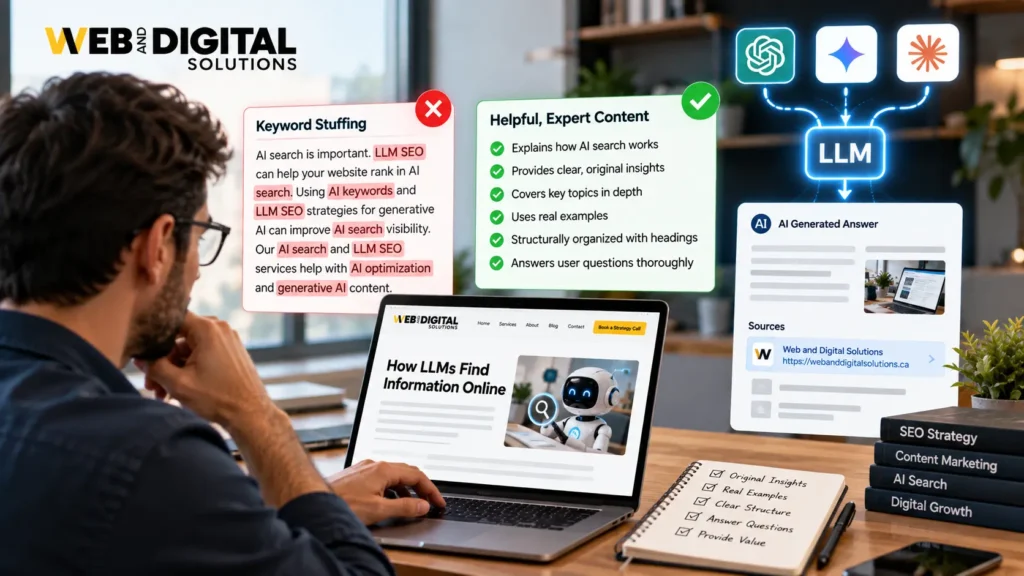
One common mistake is treating AI search optimization as a keyword insertion exercise.
Adding phrases such as “AI search,” “LLM SEO” or “generative AI” repeatedly throughout a page does not automatically make the page useful to AI systems.
The better approach is to demonstrate expertise around the actual subject.
For example, a page discussing AI search visibility could address:
- How AI-generated answers differ from traditional results
- How websites can establish topical authority
- Why structured information matters
- How content quality affects source selection
- What makes information easy to interpret
- How brand mentions and citations can contribute to visibility
The focus should remain on answering the user’s question thoroughly and accurately.
Build Content That Can Stand on Its Own
AI search increases the importance of self-contained information.
A page should not force a reader to visit five other pages simply to understand a basic concept.
That does not mean every article needs to explain everything.
Instead, provide enough context for the specific question being answered, then use relevant internal links for deeper information.
For example, if an article discusses LLM visibility, it could explain the basic concept, provide practical considerations and then direct readers to a specialist service page for implementation.
This creates a better experience than using the article as a thin promotional page.
First-Hand Expertise Can Strengthen Your Content
Businesses have an advantage that generic publishers often do not: real experience.
If your company has worked with websites, SEO campaigns, content strategies or technical optimization, that experience can inform your content.
Instead of writing:
“Businesses should improve their online presence.”
Explain what you have actually observed.
For example:
A service page may receive strong organic visibility but generate little engagement because the page does not clearly communicate who the service is for. Improving the information architecture, messaging and supporting evidence can make the page more useful to both visitors and search systems.
These practical observations create stronger content than generic definitions.
What Businesses Should Do Now
Businesses preparing for AI-driven search do not necessarily need to rebuild their entire SEO strategy.
Start with the fundamentals.
1. Identify your important topics
List the questions customers ask before choosing your product or service.
These become potential content opportunities.
2. Strengthen important pages
Review your core service and product pages.
Make sure they clearly explain:
- What you offer
- Who it is for
- Where you operate
- What makes your approach different
- Why customers should trust you
3. Create supporting content
Build useful articles around questions related to your core services.
The purpose should be to answer genuine customer questions, not simply generate more URLs.
4. Connect related pages
Use descriptive internal links to establish relationships between guides, services and supporting resources.
5. Demonstrate expertise
Include relevant examples, original insights, experience and evidence wherever possible.
6. Keep technical SEO healthy
AI search does not remove the importance of technical fundamentals.
Crawlability, indexability, page performance, structured information, mobile usability and clean site architecture still matter.
AI Search Visibility Is Becoming Part of the Broader SEO Picture
The rise of LLMs does not mean traditional SEO suddenly stops mattering.
Search engines and AI systems still need useful, accessible and understandable information.
The difference is that businesses now have another discovery environment to consider.
Instead of asking only:
“How do we rank for this keyword?”
Businesses can also ask:
“Does our website provide the information an AI system would find useful when answering this question?”
That shift changes how content strategies are planned.
It encourages businesses to focus more heavily on expertise, information quality, topical relationships and the usefulness of individual pages.
Prepare Your Website for How People Search Next
Understanding how LLMs find information online is becoming increasingly important as customers use AI tools alongside traditional search engines.
There is no guaranteed formula for being mentioned in every AI-generated answer. AI systems differ, their retrieval processes can change, and visibility can depend heavily on the question being asked.
What businesses can control is the quality of the information they publish.
Build pages that clearly explain your expertise. Create useful supporting resources. Connect related topics logically. Maintain strong technical foundations. Most importantly, give users information that genuinely helps them make decisions.
For businesses that want to go further, Web & Digital Solutions can help develop an AI search strategy that connects content, technical SEO and website structure with emerging search behaviour. The objective is not simply to add AI terminology to existing SEO work. It is to make your website more useful and discoverable as search continues to evolve.
Suggested FAQs
How do LLMs find information online?
LLMs can use information obtained through their training data, connected search or retrieval systems, and other available sources depending on the platform and query. The exact process varies between AI systems and is not always publicly documented.
How can I improve my website’s visibility in AI search?
Focus on clear, useful and original content, strong topical relevance, logical website structure, internal linking, technical accessibility and evidence of expertise. There is no guaranteed method for appearing in every AI-generated response.
Does traditional SEO still matter for AI search?
Yes. Technical accessibility, relevant content, clear site structure and authoritative information remain important foundations. AI search adds another visibility consideration rather than completely replacing traditional SEO.
What is LLM SEO?
LLM SEO refers broadly to optimizing a website’s content and information structure so that it can be better understood and potentially surfaced or referenced by AI systems that use large language models. The practices and terminology are still evolving.
Can AI search optimization guarantee mentions in ChatGPT?
No. AI platforms use different systems and retrieval methods, and their responses can vary based on the query, available sources and system updates. Optimization can improve the quality and accessibility of information but cannot guarantee a specific AI citation or mention.