Small businesses rarely have unlimited marketing budgets. Choosing between SEO, paid advertising, social media, content, email, and other digital marketing channels can therefore become difficult. The right starting point depends on your business stage, competition, sales cycle, customer value, existing traffic, and the result you need from marketing.
Why should you prioritize marketing channels?
A common mistake is trying to use every marketing channel at the same time.
A business may start SEO, run Google Ads, post on social media, publish blogs, send emails, and invest in a new website without knowing which activity should receive the most attention.
The result can be a marketing budget spread too thin.
Each channel can have a different purpose. SEO may help build long-term search visibility. Paid advertising can generate targeted traffic more quickly. Content can help answer customer questions, while email can support existing leads and customers.
The question is not simply which channel is good.
The better question is:
Which channel addresses the biggest growth opportunity in your business right now?
That answer can change as the business grows.
What should you consider before choosing a marketing channel?
Before putting more money into a specific channel, look at the business from several angles.
Consider:
- Your current website traffic
- Existing search visibility
- Level of competition
- Customer acquisition cost
- Average customer value
- Sales cycle length
- Available marketing budget
- Geographic market
- Brand awareness
- How quickly you need results
A local service business with strong search demand may have different priorities from a new e-commerce company.
Similarly, a B2B business with a six-month sales cycle may need a different approach from a company selling lower-cost products with an immediate purchase decision.
Your marketing channel should fit the way customers actually buy.
How does business maturity affect your marketing budget?
The stage of your business can influence where your budget should go first.
A new business may need to establish its website, positioning, basic search visibility, and conversion paths before investing heavily in traffic generation.
An established business with steady organic traffic may have a different problem. It may need to improve conversion rates, expand into new search terms, or use paid campaigns to reach additional customers.
Businesses can broadly assess their position as:
New businesses
Focus on building the foundation.
This may include:
- A professional website
- Clear service or product pages
- Local or organic search visibility
- Conversion opportunities
- Basic analytics and tracking
- Strong business information
There is little value in generating large amounts of traffic if the website is not ready to convert it.
Growing businesses
The focus can shift toward increasing qualified traffic and leads.
This may involve:
- SEO expansion
- Content development
- Local SEO
- Paid search
- Landing page optimization
- Conversion improvements
Established businesses
Established businesses may have enough data to make more specific investment decisions.
At this stage, the focus may include improving customer acquisition costs, expanding into new markets, increasing customer value, or combining several channels around specific campaigns.
The important point is that the same budget allocation does not make sense for every business.
When should small businesses prioritize SEO?
SEO can be useful when customers actively search for the products or services a business provides.
For example, someone searching for “digital marketing agency London Ontario” already has a specific need. A business appearing for that search has an opportunity to attract a relevant visitor without paying for every individual click.
SEO can be particularly useful when:
- Search demand exists for your services
- Customers research before contacting you
- Your market is competitive
- You want long-term organic visibility
- Your website has room for additional relevant pages
- You can wait for results to build over time
SEO is not always an immediate lead-generation solution.
It generally requires time to build visibility, improve pages, create useful content, and establish authority.
For businesses that already receive organic traffic, improving the pages attracting that traffic can sometimes be more useful than simply creating more content.
When does paid advertising make more sense?
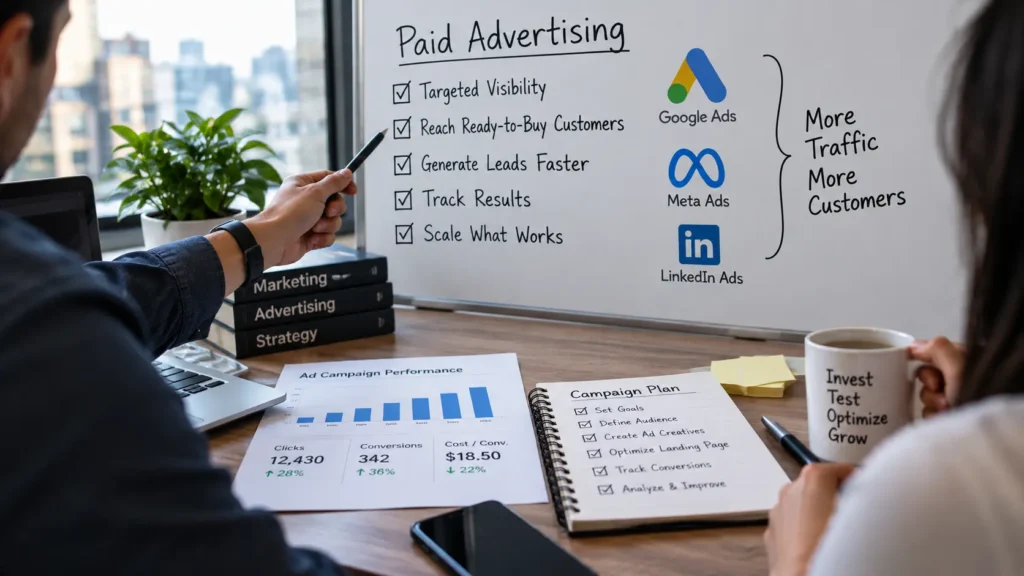
Paid advertising can be useful when a business needs targeted visibility and has a clear offer that can convert visitors.
Google Ads, for example, can place a business in front of people actively searching for selected services.
Paid campaigns may be worth considering when:
- Search demand is already strong
- You need traffic sooner
- The offer has clear commercial intent
- Landing pages are ready
- Leads can be tracked
- The business can support the cost per lead
But paid traffic does not automatically mean profitable growth.
If a landing page is unclear or the targeting is too broad, increasing the advertising budget can simply increase spending.
Before scaling paid campaigns, understand how much a qualified lead is worth to the business.
Blog you might like: Organic SEO vs Paid Ads
What role does content play in lead generation?
Content is often treated as a separate marketing activity, but it can support several stages of the customer journey.
A potential customer may not be ready to contact a business immediately.
They may first search for:
- How a service works
- What something costs
- Which option is suitable
- Common problems
- Questions about a product
- Differences between competing solutions
Useful content can help answer these questions.
It can also support SEO by creating additional opportunities to appear for relevant searches.
However, content should have a purpose.
Publishing large numbers of articles without considering search intent, customer needs, or commercial relevance can create traffic without producing meaningful enquiries.
Content should support the broader lead generation channels rather than operate separately from them.
Should small businesses invest in social media first?
Social media can help businesses build awareness, demonstrate expertise, communicate with customers, and support brand recognition.
It can be particularly relevant for businesses where visual content, community engagement, personality, or frequent customer interaction influence buying decisions.
But social media should not automatically receive the largest portion of the budget.
Ask what you need social media to accomplish.
If the objective is direct lead generation, determine whether your audience is actively using the platform and whether the business can measure enquiries or conversions from it.
If the objective is brand awareness, different measurements may be more relevant.
The channel should be evaluated against its purpose rather than follower numbers alone.
How does customer value affect your marketing budget?
Customer value is one of the most important factors when deciding how much to invest in marketing.
Consider two businesses.
One sells a product for $30.
Another provides a service worth $5,000 per customer.
They cannot necessarily use the same customer acquisition approach.
A high-value service may be able to spend more to acquire a qualified lead because one new customer can generate substantially more revenue.
This does not mean expensive advertising is automatically justified.
The business still needs to understand:
- Cost per lead
- Lead-to-customer conversion rate
- Average customer value
- Gross margin
- Customer lifetime value
- Sales and follow-up costs
Marketing investment should be considered alongside the economics of acquiring and retaining customers.
How does competition change channel priorities?
Competition can also affect where your budget should go.
If competitors dominate organic search, SEO may require a longer-term investment in technical improvements, content, service pages, links, and authority.
If paid advertising is highly competitive, the cost of acquiring clicks may be higher.
In some markets, a business may find opportunities through more specific services, locations, customer segments, or content topics rather than competing immediately for the broadest terms.
This is why copying a competitor’s marketing mix does not necessarily make sense.
Their budget, brand recognition, customer value, website authority, and business objectives may be completely different.
What if your business already gets website traffic?
If you already have traffic, do not automatically assume you need more.
First determine what happens after visitors arrive.
Check:
- Which pages receive the most traffic
- Which pages generate enquiries
- Where visitors leave
- Which traffic sources produce qualified leads
- Whether important service pages convert
- Whether calls and forms are being tracked
- Whether mobile visitors can easily take action
A business receiving 5,000 relevant visitors with a strong conversion process may create more value than one receiving 20,000 visitors with very few enquiries.
This is where digital marketing services should connect traffic generation with conversion improvement.
How should a small business divide its marketing budget?
There is no universal percentage that every business should follow.
Instead, prioritize based on the biggest current gap.
A practical framework is:
- Fix the foundation
Make sure the website, tracking, service information, and conversion paths are working.
- Identify existing demand
Look at search demand, website traffic, customer behaviour, and existing lead sources.
- Choose the channel closest to the business objective
If people are already searching for your services, search marketing may be important. If awareness is the primary challenge, other channels may need more attention.
- Test before scaling
Start with a measurable activity and evaluate the quality of the traffic or leads it produces.
- Reallocate based on results
Marketing budgets should not remain fixed simply because they were approved at the beginning of the year.
If one channel consistently produces relevant opportunities while another produces limited business value, the allocation may need to change.
What is the right digital marketing channel for your business?
The right choice depends on where your business currently stands.
A business with little organic visibility may need to build its search foundation. A company with strong rankings but poor conversion rates may need to improve its website. A business with a proven offer and clear landing pages may be ready to test paid campaigns.
The important thing is to avoid choosing channels simply because they are popular.
Look at your:
- Business maturity
- Competition
- Customer value
- Sales cycle
- Existing traffic
- Search demand
- Conversion rate
- Marketing objectives
This creates a more practical online marketing strategy than dividing the budget equally across every available channel.
Build your marketing budget around growth opportunities
Marketing works better when investment follows the actual needs of the business.
Start with the biggest gap. Then choose the channel that can address it, establish a way to measure the result, and review the performance before increasing the investment.
For some small businesses, that may mean strengthening SEO and local visibility. For others, it may mean improving conversion paths before spending more on traffic. Paid advertising, content, social media, email, and other channels can all play a role when they support a clear objective.
Web and Digital Solutions helps businesses evaluate their digital presence and connect marketing activities with broader growth objectives. The right strategy is not about using every channel. It is about putting resources where they can address the next meaningful growth opportunity.
Frequently Asked Questions
Which digital marketing channel should a small business use first?
There is no single channel that works first for every small business. The decision depends on search demand, competition, business maturity, customer value, sales cycle, existing traffic, and marketing goals. Businesses should identify their biggest current growth gap before deciding where to allocate their budget.
How much should a small business spend on digital marketing?
The appropriate budget depends on the business model, customer value, competition, growth objectives, and available resources. Instead of choosing a budget based only on industry averages, businesses should consider what they can afford to invest, what a qualified customer is worth, and which channels can be measured.
Is SEO or paid advertising better for small businesses?
SEO and paid advertising serve different purposes. SEO can build organic visibility over time, while paid advertising can provide targeted traffic more quickly. The right option depends on search demand, competition, budget, conversion performance, and how quickly the business needs results.
Should a business invest in multiple marketing channels?
Multiple channels can work together when each has a clear purpose. SEO may generate organic visibility, content can support research, paid advertising can reach targeted audiences, and website optimization can improve conversions. The key is coordinating the channels rather than spreading the budget across them without a clear objective.
How can a business know if its marketing budget is working?
Track metrics that connect marketing activity to business outcomes. Depending on the business, these may include qualified traffic, leads, phone calls, conversion rates, cost per lead, customer acquisition cost, and revenue. Reviewing these metrics helps identify which activities are contributing to meaningful opportunities.