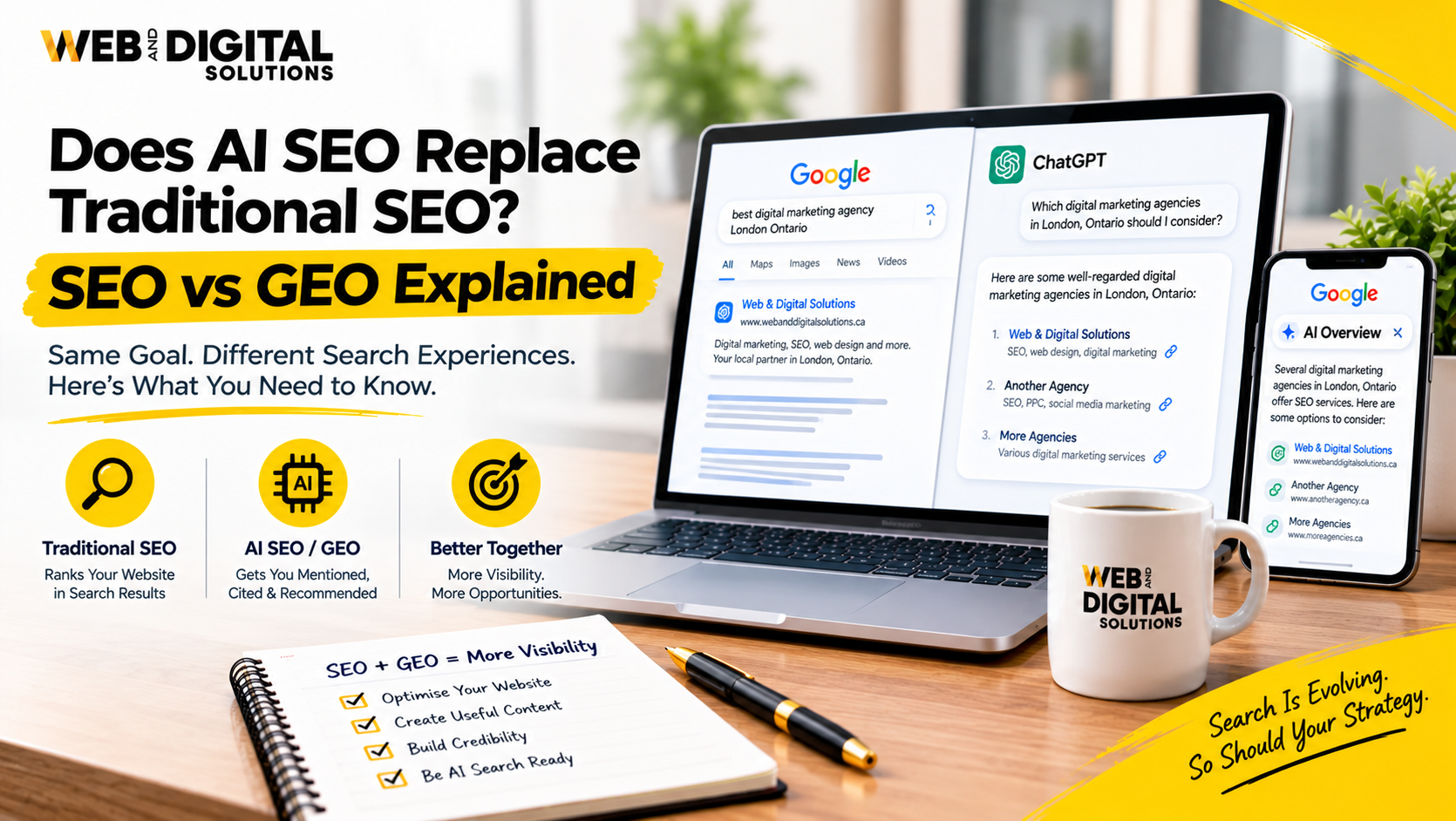
Google Search is evolving. Instead of always showing users a traditional list of website links, Google can now generate AI-powered summaries that explain a topic, answer questions, and provide links to supporting websites.
These summaries are called Google AI Overviews.
For businesses, this creates another opportunity to reach potential customers. Someone researching a service, comparing solutions, or looking for a local provider may encounter an AI Overview before exploring individual websites.
Naturally, many website owners are asking: How can I make my website appear in Google AI Overviews?
The most important thing to understand is that Google does not require a separate AI Overview optimisation technique. Your pages must meet Google’s normal Search eligibility requirements, and your content should be useful, reliable, accessible, and relevant to the user’s query.
This guide explains how AI Overviews work, what your website needs to be eligible, which SEO improvements are worth prioritising, and how to monitor your visibility.
What Are Google AI Overviews?
Google AI Overviews are AI-generated summaries that can appear within Google Search results for certain queries.
They are designed to help users understand a topic or find information more quickly. An Overview may combine information from multiple sources and display links to websites that can provide further details.
For example, someone searching for:
“How can a small business improve its local SEO?”
may see an AI-generated explanation covering Google Business Profile optimisation, local landing pages, reviews, and website improvements, along with links to relevant sources.
AI Overviews do not appear for every search. Google determines when an AI-generated summary may add value to the search experience.
For businesses, the opportunity is to create pages that are eligible, relevant, and useful enough to be considered as supporting sources.
How Do Google AI Overviews Select Website Content?
Google’s AI search features are built on its existing Search systems. They use information from Google’s Search index to help generate responses and identify supporting links.
Google also describes the use of retrieval-augmented generation (RAG), where relevant information is retrieved from its Search index to help ground AI-generated responses.
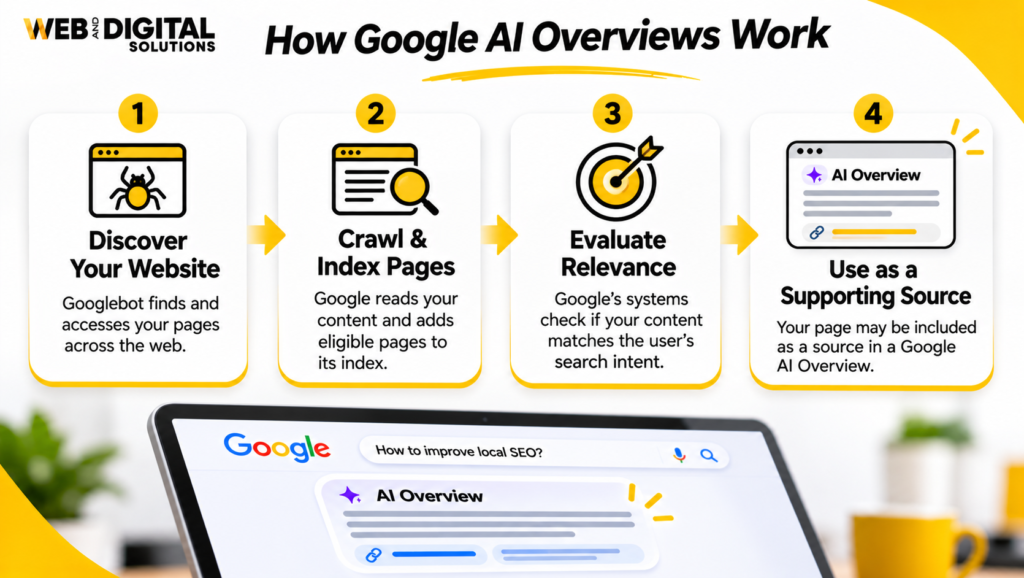
A simplified process looks like this:
1. Google Discovers Your Website
Googlebot needs to be able to access your website and discover its important pages.
Your content can be easier to discover when your website has:
- A clear navigation structure.
- Relevant internal links.
- An accurate XML sitemap.
- Accessible page content.
- No unnecessary crawling restrictions.
2. Google Crawls and Indexes Your Pages
Your pages need to meet Google’s technical requirements and be eligible to appear in Search with a snippet.
A page that is blocked from crawling, marked noindex, or affected by technical problems may not be eligible for AI Overview supporting links.
3. Google’s Systems Evaluate Relevance
The page must be relevant to the user’s search.
For example, an article explaining local SEO costs may be relevant to a question about local SEO pricing, but it may not be the most useful source for a query about technical website errors.
Search intent and content relevance matter.
4. Google May Use Relevant Pages as Supporting Sources
If Google’s systems determine that an AI Overview is appropriate for a query, they may display links to relevant webpages that support the generated response.
Meeting eligibility requirements does not guarantee that a page will be selected.
Important: Google states that there are no additional technical requirements or special optimisations specifically needed to appear in AI Overviews. Its existing SEO fundamentals remain relevant. Read Google’s official AI features and your website documentation.
9 Practical Ways to Improve Your Website’s AI Overview Visibility
The following recommendations focus on established Google Search practices rather than unsupported AI ranking tricks.
1. Make Sure Your Website Is Indexed and Eligible for Google Search
This is the starting point.
Google’s guidance states that a page must be indexed and eligible to appear in Google Search with a snippet to be eligible as a supporting link in AI Overviews.
Start by reviewing your most important pages in Google Search Console.
Check:
- Whether important pages are indexed.
- Whether Google can crawl the pages.
- Whether pages contain accidental noindex directives.
- Whether robots.txt blocks important resources.
- Whether canonical tags point to the intended URLs.
- Whether pages return successful HTTP responses.
- Whether important content is accessible to Googlebot.
Use the URL Inspection tool to investigate individual URLs and the Page Indexing report to identify broader patterns.
Remember that submitting a sitemap or requesting indexing does not guarantee that Google will index or display a page.
2. Check Your Website’s Search Generative AI Control
Google introduced a Search generative AI control in Search Console to let website owners manage whether their content can be included in Google Search generative AI features.
According to Google’s documentation, this control rolled out worldwide as of August 31, 2026.
You can review it through:
Google Search Console → Settings → Search generative AI
The available setting allows website owners to manage inclusion in generative AI features such as AI Overviews, AI Mode, and generative AI features in Google Discover.
If your objective is to allow your website’s content and links to be used in these features, review the current selection for your property.
Do not confuse this setting with a ranking boost. Allowing inclusion makes your site eligible under this control; it does not guarantee that Google will select your content.
You can read Google’s official Search generative AI control documentation.
3. Publish Helpful Content That Answers Real Questions
Content quality remains one of the most important areas to prioritise.
A page should provide information that genuinely helps visitors rather than simply repeating keywords or summarising what other websites have already published.
For example, a digital marketing agency could create useful content around questions such as:
- What does local SEO include?
- How much does SEO cost for a small business?
- Why is my website not ranking on Google?
- What is the difference between SEO and AI SEO?
- How can I improve my Google Business Profile?
A useful article should:
- Address the main question clearly.
- Explain the topic in sufficient detail.
- Include practical examples where appropriate.
- Support factual claims with reliable sources.
- Explain relevant limitations or exceptions.
- Provide a logical next step for readers.
Avoid creating multiple articles that target slightly different keyword variations but offer almost identical information.
The objective is to publish something worth reading, referencing, and sharing.
4. Match Content to Search Intent
Not every search query requires the same type of answer.
Someone searching “what is technical SEO?” needs an explanation. Someone searching “technical SEO audit services” is more likely to be evaluating providers.
Your website should address these different needs with appropriate content.
| Search intent | Example query | Suitable content |
|---|---|---|
| Informational | What is local SEO? | Detailed educational article |
| Commercial investigation | Best SEO services for small businesses | Comparison or service evaluation guide |
| Transactional | Hire an SEO company in London Ontario | Dedicated service or contact page |
| Local | SEO agency near me | Relevant local business and service information |
Review the search results for your target queries to understand what types of pages Google considers relevant.
Do not force every keyword into a blog post. Some searches deserve dedicated service pages, while others are better addressed through educational content.
5. Build Clear and Detailed Service Pages
Your service pages should explain exactly what your business offers.
A page that only says “We provide professional digital marketing solutions” does not give visitors much information.
A stronger page explains:
- What the service includes.
- Which business problems it addresses.
- Who can benefit from it.
- What the process involves.
- Which locations are served.
- What makes the service different.
- How a potential customer can get started.
For example, a page about SEO services should explain the role of technical SEO, keyword research, on-page optimisation, content planning, internal linking, and local SEO.
Keep claims accurate and support results or experience statements with genuine evidence.
6. Strengthen Your Website’s Internal Linking
Internal links help Google discover pages and understand relationships between topics on your website.
They also help visitors move from educational content to relevant services.
For example, an article about local search visibility could naturally link to:
- Your Local SEO service page.
- A guide to Google Business Profile optimisation.
- An article about local keyword research.
- A relevant contact page.
Use descriptive anchor text that explains what the linked page is about.
Avoid adding unrelated links simply to increase the number of internal links on a page.
Review your website for important pages that have few or no internal links pointing to them. Make sure your key services are easy to reach from relevant articles and navigation sections.
7. Demonstrate Expertise and Support Important Claims
Businesses should provide information that readers can evaluate and trust.
Google’s people-first content guidance encourages useful, original, reliable content that demonstrates experience and expertise where appropriate.
Practical ways to strengthen content include:
- Providing original examples.
- Explaining your process.
- Publishing genuine case studies.
- Including accurate data where available.
- Linking to reliable references.
- Showing relevant business experience.
- Providing clear business and contact information.
- Keeping information updated when facts change.
For example, an agency explaining an SEO audit can describe the technical checks it performs, the issues it prioritises, and how recommendations are connected to business objectives.
Do not invent customer results, credentials, statistics, or testimonials.
8. Make Important Information Available in Readable Text
Google needs to be able to access and understand the important information on your webpages.
If a page contains essential service details only inside an image, video, or inaccessible interactive element, that information may be harder for Google to process.
Use readable HTML text for:
- Service descriptions.
- Product information.
- Important instructions.
- Key comparisons.
- Article content.
- Contact details.
Support your content with high-quality images and videos where they add value.
Also make sure your pages are usable on mobile devices and that important information is not hidden behind unnecessary interactions.
9. Use Structured Data Correctly, but Do Not Treat It as an AI Shortcut
Structured data can help search engines understand information about your website and its pages.
Depending on the page, relevant schema types may include:
| Schema type | Suitable use |
|---|---|
| Organization | Business or organisation information |
| LocalBusiness | Details about a qualifying local business |
| Service | Description of a service |
| Article / BlogPosting | Blog article information |
| BreadcrumbList | Website navigation hierarchy |
However, Google explicitly states that there is no special schema.org structured data required for AI Overviews.
Continue using appropriate structured data as part of your overall SEO strategy, but ensure it accurately reflects the visible content.
Do not add unnecessary schema, fake reviews, or unsupported claims in an attempt to gain AI Overview placement.
Common AI Overview SEO Myths You Should Avoid
There is plenty of advice online promising quick ways to appear in Google’s AI-generated results. Some recommendations are not supported by Google’s own guidance.
| Common claim | What Google’s guidance indicates |
|---|---|
| You need special AI Overview schema. | No special schema.org markup is required. |
| You must create an llms.txt file. | Google says it does not use llms.txt for Search visibility. |
| Every article must be divided into tiny content chunks. | There is no special chunking requirement. |
| You need to publish hundreds of AI-generated articles. | Focus on original, useful, reliable content rather than mass production. |
| Ranking first guarantees an AI Overview citation. | Search eligibility does not guarantee selection as a supporting source. |
| You need a separate AI SEO website. | Your existing website can be optimised using established Search fundamentals. |
| Structured data guarantees AI placement. | Structured data is not a guarantee of inclusion in AI Overviews. |
Google’s guidance is clear: prioritise useful content and established SEO practices over unsupported AI optimisation shortcuts.
For additional detail, review Google’s guide to optimising websites for generative AI features.
How to Measure Your Website’s AI Overview Visibility
Improving visibility is only one part of the process. You also need to understand whether your work is producing meaningful results.
Google Search Console provides reporting for Search performance, and Google has introduced a Generative AI performance report to help website owners understand visibility in its generative AI features.
Use the reporting available for your property to review:
- Search impressions and clicks.
- Pages receiving search visibility.
- Search queries associated with your website.
- Available generative AI performance data.
- Changes after content or technical improvements.
You can also maintain a separate manual monitoring process.
For example, test a consistent set of relevant queries and record whether your website appears as a supporting source.
| Metric | What it helps you understand |
|---|---|
| Organic clicks | Whether people are visiting through Google Search |
| Search impressions | How often your pages are shown in eligible search results |
| AI Overview citations | Whether your pages appear as supporting sources when manually checked |
| Cited URLs | Which pages are being referenced |
| Qualified enquiries | Whether search visibility contributes to business opportunities |
Do not assume that every AI Overview impression or citation can be measured as a separate, complete metric in every Search Console property. Use the reporting Google makes available and supplement it with consistent observations.
A citation is useful visibility, but qualified traffic and conversions remain important business outcomes.
How Long Does It Take to Appear in Google AI Overviews?
There is no guaranteed timeline.
A page may already be indexed and eligible for Search but still not appear as a supporting link in an AI Overview.
The outcome depends on factors such as:
- Query relevance.
- Search intent.
- Content usefulness and accuracy.
- Technical accessibility.
- Google’s Search systems.
- The sources selected for a particular response.
- Whether Google decides to show an AI Overview for that query.
Technical improvements may help resolve eligibility problems, but they do not guarantee placement.
A sensible approach is to prioritise technical fixes, improve important pages, publish genuinely useful content, and monitor results consistently.
How Web & Digital Solutions Can Help With AI Search Optimization
At Web & Digital Solutions, we help businesses strengthen their search visibility through technical SEO, content optimisation, and AI search optimisation.
Our approach can include:
- Reviewing website crawlability and indexability.
- Identifying technical SEO issues.
- Reviewing Search Console performance.
- Improving service-page content and search intent alignment.
- Developing useful supporting articles.
- Strengthening internal linking and website structure.
- Reviewing structured data implementation.
- Monitoring available AI search visibility indicators.
- Connecting SEO improvements with business goals.
If your business wants to improve its visibility across traditional Google Search and emerging AI-powered search experiences, explore our AI Search Optimization Services in London, Ontario.
You can also learn more about our SEO Services in London, Ontario.
Final Thoughts: Focus on Search Fundamentals, Not AI Overview Tricks
Appearing in Google AI Overviews is not a matter of adding a special tag or publishing content in a particular format.
Google’s guidance points website owners towards the same foundations that support traditional Search: technical accessibility, indexing eligibility, useful content, clear website structure, and reliable information.
Start by checking your important pages in Search Console. Review the Search generative AI control, fix technical barriers, and make sure your content genuinely addresses the questions your customers ask.
Then monitor performance and improve the pages that matter most to your business.
The goal is not to chase a single AI Overview placement. It is to build a website that deserves to be discovered, visited, and trusted.
If you need help assessing your website’s readiness for AI-powered search, contact Web & Digital Solutions to discuss your SEO requirements.
Frequently Asked Questions About Google AI Overviews
1. How can I make my website appear in Google AI Overviews?
Make sure your important pages are indexed and eligible to appear in Google Search with a snippet. Allow Googlebot to crawl relevant content, publish helpful and reliable information, build clear internal links, and review the Search generative AI control in Search Console. These steps support eligibility but do not guarantee placement.
2. Do I need special schema markup for Google AI Overviews?
No. Google states that there is no special schema.org structured data required for AI Overviews. Continue using relevant structured data where appropriate for your overall SEO strategy, and make sure it accurately matches visible page content.
3. Does ranking on the first page of Google guarantee an AI Overview citation?
No. A strong organic ranking does not guarantee that Google will cite a page in an AI Overview. Google selects supporting sources based on its systems and the relevance of information to the query.
4. Is AI Overview optimisation different from traditional SEO?
Google’s AI features are built on its existing Search systems, so traditional SEO fundamentals remain important. Website accessibility, indexing eligibility, useful content, and clear structure can support visibility in both conventional Search and AI-generated experiences.
5. Does Google use llms.txt for AI Overviews?
Google’s published guidance says it does not use llms.txt or similar AI-specific text files for Google Search visibility, including its generative AI features. Creating one is not a requirement for appearing in AI Overviews.
6. How can I track whether my website appears in AI Overviews?
Use Google Search Console to review available Search performance and Generative AI reporting for your property. You can also manually test relevant search queries and record whether your pages appear as supporting sources. Track organic visits and qualified enquiries alongside visibility.
7. How long does it take to appear in Google AI Overviews?
There is no fixed timeline. Even if a page is indexed and eligible for Google Search, its inclusion in an AI Overview is not guaranteed. Results depend on query relevance, available sources, content quality, and Google’s systems.