How Long Does It Take to Rank on Google? SEO Results Explained
One of the most common questions business owners ask before investing in search engine optimization is: How long does it take to rank on Google?
You want to know when your website will start appearing higher in search results, attracting organic visitors, and generating enquiries. You also want to understand whether your SEO investment is moving in the right direction.
The honest answer is that SEO takes time, and there is no guaranteed ranking deadline. Some websites begin seeing measurable improvements within a few months, while others need six months, a year, or longer to compete for valuable search terms.
The timeline depends on several factors, including your website’s history, keyword competition, technical health, content quality, backlinks, and the consistency of your SEO strategy.
In this guide, we explain the typical SEO ranking timeline, what influences results, and how to measure progress beyond keyword positions.
How Long Does SEO Take to Show Results?
For many websites, measurable SEO improvements may begin appearing within approximately 3 to 6 months. More competitive keywords and industries may require 6 to 12 months or longer to achieve stronger organic visibility.
These are general planning estimates, not guaranteed results. A website with an existing SEO foundation may progress faster than a brand-new website with technical issues and no established content.
It is also important to understand that SEO results happen in stages:
- Crawling: Google discovers and accesses your website pages.
- Indexing: Google processes a page and may include it in its search index.
- Initial visibility: Your page starts appearing for relevant search queries.
- Ranking improvements: Your page moves higher in search results.
- Organic traffic growth: More visitors arrive through unpaid search results.
- Conversions: Visitors take valuable actions, such as calling, submitting a form, or requesting a quote.
These milestones are different. A page can be indexed without ranking prominently, and higher rankings do not automatically guarantee more leads.
A Realistic SEO Ranking Timeline
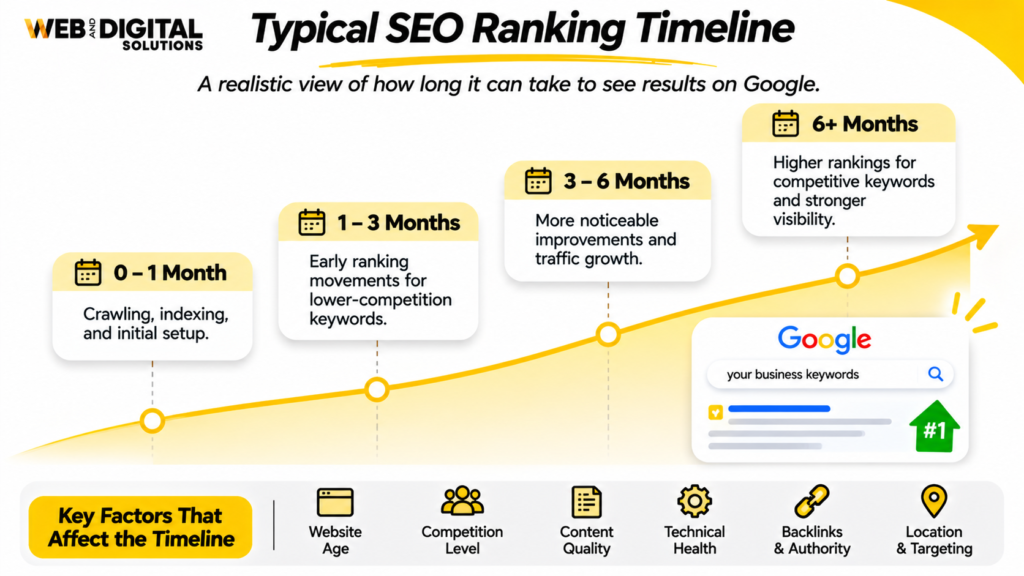
SEO is a gradual process. Understanding the typical stages helps businesses set realistic expectations and evaluate progress more effectively.
The following timeline is a general framework. Your actual results may vary depending on your industry, website condition, competitors, and SEO implementation.
Month 1: Website Audit and SEO Foundation
The first month generally focuses on identifying issues and building an SEO strategy.
Typical activities include:
- Conducting a technical SEO audit.
- Reviewing existing keyword rankings and organic traffic.
- Checking indexing and crawling issues.
- Analysing competitors and their search visibility.
- Reviewing page titles, meta descriptions, and headings.
- Evaluating website speed and mobile usability.
- Identifying content gaps and internal linking opportunities.
- Creating a keyword mapping and optimisation plan.
The objective is to understand what is preventing the website from performing well and prioritise improvements.
Some technical fixes may produce early positive changes, but significant ranking improvements should not be expected immediately.
Months 2–3: Content Optimisation and Search Visibility
Once the initial audit is complete, the next stage focuses on improving important website pages and making their content more relevant to target searches.
Common activities include:
- Optimising service and product pages.
- Improving content structure and search intent alignment.
- Updating titles, headings, and meta descriptions.
- Publishing relevant supporting blog content.
- Strengthening internal links.
- Improving local landing pages where appropriate.
- Monitoring indexing and search performance.
During this period, Google may discover updated pages and reassess their relevance. Some keywords may begin generating impressions or showing ranking movement.
However, early visibility does not necessarily mean that the website is ready to compete for its most valuable commercial keywords.
Months 4–6: Ranking Improvements and Organic Traffic Growth
For websites with a reasonably healthy technical foundation and consistent optimisation, this period may bring more noticeable improvements.
Potential developments include:
- Better positions for selected target keywords.
- More pages appearing in search results.
- Growth in non-branded organic impressions.
- Increased organic clicks.
- Improved visibility for long-tail keywords.
- Greater visibility for location-specific searches.
The results will depend on the competition and quality of the work implemented.
For example, a local service business targeting a specific town may have a different competitive environment from a national company targeting broad commercial keywords.
At this stage, SEO performance should be evaluated using Google Search Console and analytics data rather than relying only on a handful of keyword positions.
Months 6–12 and Beyond: Building Competitive Visibility
Competitive industries may require a longer period to achieve stronger and more stable rankings.
SEO work during this stage may include:
- Expanding topical coverage.
- Improving important commercial landing pages.
- Strengthening internal linking across related content.
- Earning relevant and trustworthy backlinks.
- Addressing competitor content gaps.
- Improving user experience and conversion paths.
- Refining keyword targeting based on performance data.
SEO does not stop when a page reaches the first page of Google. Competitors continue improving their websites, search intent evolves, and search results change.
Maintaining visibility requires ongoing monitoring and optimisation.
What Factors Affect How Long It Takes to Rank on Google?
Two websites targeting the same keyword can experience very different ranking timelines. This happens because search performance depends on several factors working together.
1. Website Age and Existing Search History
A newly launched website generally has less established search visibility than a website that has been active for several years.
An established website may already have:
- Indexed pages.
- Existing organic traffic.
- Relevant backlinks.
- Brand recognition.
- Content with existing search visibility.
- An established internal linking structure.
However, an older domain does not automatically rank higher. Website age alone is not a ranking guarantee.
An established website with outdated content, technical problems, and poor search intent alignment may perform worse than a newer website with useful content and a strong SEO foundation.
The website’s overall history and condition matter more than its registration date.
2. Keyword Competition
Keyword competition is one of the biggest reasons SEO timelines differ.
Consider these two searches:
- “Irrigation repair in a small local town”
- “Best digital marketing agency in Canada”
The first search is specific and geographically limited. The second may be dominated by established agencies, directories, and authoritative websites.
The more competitive the keyword, the more difficult it may be to achieve prominent visibility.
Before selecting target keywords, evaluate:
- How many relevant competitors appear in the results?
- Are the top-ranking pages highly relevant?
- Do established websites dominate the results?
- Is the keyword commercially valuable?
- Can your website provide a more useful or relevant answer?
A practical SEO strategy balances search volume, competition, business relevance, and realistic ranking opportunities.
3. Technical SEO Health
Technical SEO problems can prevent search engines from accessing, understanding, or indexing important pages.
Common issues include:
- Incorrect robots.txt directives.
- Unintended noindex tags.
- Broken internal links.
- Duplicate pages and incorrect canonical tags.
- Slow server response times.
- Poor mobile usability.
- Redirect errors.
- Missing or outdated XML sitemaps.
For example, if an important service page is accidentally marked as noindex, Google may exclude it from search results.
Resolving technical problems does not guarantee higher rankings, but it helps ensure that search engines can properly access and process the website.
4. Content Quality and Search Intent
Publishing more content does not automatically produce better rankings.
Your pages need to address what people are actually looking for when they enter a search query.
For example, someone searching for “SEO services London Ontario” is likely evaluating service providers. A general educational article about SEO may not satisfy that commercial intent.
Likewise, someone searching “what is technical SEO” probably wants an explanation rather than an immediate sales pitch.
Effective content should:
- Address the primary search intent.
- Provide useful and accurate information.
- Explain services clearly.
- Answer relevant customer questions.
- Use headings that make information easy to navigate.
- Include relevant internal links.
- Demonstrate experience and subject knowledge where appropriate.
Content should be created to help the intended audience, not simply to include a keyword a certain number of times.
5. Website Authority and Backlinks
Search engines use multiple signals to evaluate the relevance and credibility of web pages. Links from other websites can help search engines discover content and understand how pages relate to the wider web.
However, not all backlinks provide the same value.
A relevant mention or link from a credible website in your industry may be more useful than dozens of unrelated links from low-quality websites.
A sustainable link-building strategy should prioritise:
- Industry-relevant websites.
- Genuine business partnerships.
- Useful resource mentions.
- Relevant digital publications.
- High-quality editorial links.
- Valuable content that people naturally want to reference.
Avoid relying on bulk link packages or artificial link schemes. Poor-quality link building can create risks rather than sustainable improvements.
6. Competitor SEO Performance
Your website does not compete against Google alone. It competes against other websites trying to satisfy the same search intent.
If competitors have stronger service pages, better content coverage, more relevant backlinks, and established brand recognition, overtaking them may take considerable effort.
A competitor analysis should examine:
- Their highest-performing landing pages.
- Their keyword coverage.
- Their content depth and relevance.
- Their internal linking.
- Their backlink profiles.
- Their local search visibility, where relevant.
The objective is not to copy competitors. It is to identify gaps and create a more useful, relevant, and competitive website experience.
7. Consistency of SEO Implementation
SEO is not a one-time activity.
A website that receives a technical audit but no further improvements may struggle to build sustained visibility.
Consistent SEO work involves:
- Monitoring keyword performance.
- Updating existing content.
- Publishing relevant new pages.
- Fixing technical issues.
- Improving internal linking.
- Reviewing competitor activity.
- Evaluating organic traffic and conversions.
The quality and consistency of implementation can influence how quickly a website develops stronger organic visibility.
Does a New Website Take Longer to Rank on Google?
A new website often needs more time to establish search visibility because it may have limited content, few external references, and no established organic performance history.
However, a new website can still gain visibility for relevant search terms if it has:
- A technically accessible structure.
- Clear and useful service pages.
- Content aligned with search intent.
- A logical internal linking structure.
- Relevant business information.
- A consistent content and optimisation strategy.
It is usually more practical for a new website to begin with specific, relevant keywords rather than immediately targeting highly competitive national terms.
For example, a new local business may initially focus on service-related searches in its target area before expanding into broader keyword opportunities.
Can You Rank on Google in 30 Days?
It is possible for a page to become indexed and appear in search results within 30 days. Some websites may also experience early ranking improvements during this period.
However, ranking on the first page for a competitive keyword within 30 days is not a realistic promise for most websites.
The timeline depends on:
- Whether Google can discover and index the page.
- How competitive the target keyword is.
- Whether the website has existing authority.
- How relevant the page is to the search query.
- Whether technical barriers are present.
A provider promising guaranteed first-page rankings within 30 days should be evaluated carefully.
Ask what keywords are being targeted, what work will be completed, and how performance will be measured.
How Do You Measure SEO Progress Before Reaching Page One?
One common mistake businesses make is judging SEO success only by whether their website has reached the first page.
Ranking positions matter, but they are only one part of the picture.
You should monitor several indicators throughout the campaign.
| SEO metric | What it tells you |
|---|---|
| Impressions | How often your website appears in Google search results. |
| Organic clicks | How many visitors click through from unpaid search results. |
| Average position | The average position of your website for selected searches in Search Console. |
| Keyword visibility | Whether important keywords are gaining or losing search visibility. |
| Indexed pages | Whether important pages are included in Google’s index. |
| Organic sessions | How much website traffic comes from organic search. |
| Conversion rate | How effectively organic visitors complete valuable actions. |
| Leads and enquiries | Whether organic traffic is contributing to business opportunities. |
Google Search Console is particularly useful for monitoring impressions, clicks, queries, and page performance.
Google Analytics 4 can help evaluate what visitors do after arriving on the website.
A campaign can show positive progress before major keyword milestones are reached. For example, an increase in relevant impressions may indicate that more pages are becoming visible for target searches.
However, traffic quality and business outcomes must remain central to the evaluation.
How Can You Improve Your Chances of Ranking Faster?
Although no SEO strategy can guarantee a specific ranking deadline, you can reduce avoidable delays and improve your website’s ability to compete.
Here are eight practical priorities.
1. Fix Critical Technical SEO Issues
Start by resolving problems that prevent important pages from being crawled, indexed, or understood.
Review robots.txt, noindex tags, canonical tags, redirects, broken links, and sitemap configuration.
2. Target Realistic Keywords
Do not focus exclusively on high-volume keywords.
Identify specific search terms that match your services, location, and customer intent. Long-tail and local keywords may offer more realistic opportunities, depending on the competition.
3. Optimise Important Service Pages
Your service pages should clearly explain what you offer, who you serve, and why customers should consider your business.
Include relevant service details, useful information, clear headings, and appropriate calls to action.
4. Publish Supporting Content
Create useful blog articles that answer questions related to your services.
For example, an SEO agency could publish content about keyword research, technical SEO, local search visibility, and website optimisation.
Connect relevant articles to the appropriate service pages through contextual internal links.
5. Improve Internal Linking
Internal links help visitors navigate your website and help search engines discover relationships between pages.
Link supporting articles to relevant service pages and connect related content naturally.
6. Build Relevant Backlinks
Focus on earning credible references from relevant websites rather than chasing a high backlink count.
Prioritise relevance, quality, and genuine editorial value.
7. Strengthen Local SEO
For businesses serving a defined geographic area, local SEO can improve visibility for relevant location-based searches.
Keep business information consistent, maintain an accurate Google Business Profile, collect genuine customer reviews, and create useful location-specific website content where appropriate.
8. Monitor and Improve Performance
Review Search Console and analytics data regularly.
Identify pages gaining impressions, queries with improving positions, content that needs updating, and landing pages that attract visitors but generate few enquiries.
Use the data to decide what to improve next.
When Should You Expect SEO to Generate Leads?
Ranking improvements and lead generation are related, but they are not the same thing.
A website can attract organic traffic without generating enquiries if visitors cannot find the information they need or do not see a compelling reason to contact the business.
Lead generation depends on factors such as:
- Whether the keywords attract potential customers.
- Whether landing pages clearly explain the service.
- Whether pricing, service areas, and contact information are easy to find.
- Whether the website builds trust.
- Whether calls to action are visible.
- Whether contact forms and phone tracking work correctly.
For example, ranking for a broad informational keyword may attract visitors who are researching a topic rather than looking to hire a service provider.
A smaller amount of relevant commercial traffic may generate more business value than a large volume of unrelated visitors.
This is why SEO campaigns should measure leads, qualified enquiries, and conversions alongside rankings and traffic.
Is SEO Worth the Wait for Small Businesses?
For many small businesses, SEO can be a valuable long-term marketing channel because it helps potential customers discover relevant services while actively searching online.
Unlike paid advertising, organic search visibility does not depend on paying for every individual click. However, SEO still requires investment in strategy, content, technical improvements, and ongoing maintenance.
SEO may be particularly useful when:
- Your customers regularly search online for your services.
- Your business operates in a defined local market.
- Your website is not attracting enough qualified organic traffic.
- Competitors are gaining visibility for valuable search terms.
- You want to build a sustainable source of website enquiries.
The decision should be based on your business objectives, competitive environment, available budget, and expected return on investment.
How Web & Digital Solutions Helps Businesses Improve Google Rankings
At Web & Digital Solutions, we approach SEO as a long-term process focused on improving organic visibility and attracting relevant website visitors.
Our SEO work can include:
- SEO audits: Identifying technical, content, and on-page issues.
- Keyword research: Finding relevant search terms based on business objectives and search intent.
- On-page SEO: Improving page titles, headings, content, and internal linking.
- Technical SEO: Addressing crawling, indexing, website structure, and performance issues.
- Content optimisation: Developing useful content that supports your services and target audience.
- Local SEO: Improving local search visibility for businesses serving London, Ontario, and surrounding areas.
- Performance monitoring: Reviewing rankings, organic traffic, and meaningful conversion indicators.
Every website has different requirements. The first step is understanding your current search performance, identifying opportunities, and creating a realistic optimisation plan.
Explore our SEO services in London, Ontario to learn how we can help improve your website’s organic search performance.
You can also contact Web & Digital Solutions to discuss your SEO goals.
Frequently Asked Questions About SEO Ranking Timelines
1. How long does it take to rank on Google for a new website?
A new website may begin appearing in Google search results within weeks after its pages are discovered and indexed. However, achieving competitive rankings can take several months or longer. The timeline depends on content quality, technical SEO, keyword competition, and the website’s overall search visibility.
2. Can SEO show results in three months?
Yes. Some websites may see improvements in impressions, indexing, keyword positions, and organic clicks within three months. However, the extent of progress varies. Three months should be treated as an early performance checkpoint rather than a guaranteed deadline for first-page rankings.
3. Why is my website not ranking even after six months of SEO?
Possible reasons include targeting highly competitive keywords, technical indexing problems, weak content relevance, insufficient internal linking, limited authority, or inconsistent optimisation. Reviewing Google Search Console data and conducting a detailed SEO audit can help identify the underlying issues.
4. Does website age affect Google rankings?
Website age alone does not guarantee better rankings. An established website may have an advantage through existing content, backlinks, and search visibility, but a newer website can also compete with useful content, strong technical foundations, and relevant optimisation.
5. Do backlinks help a website rank faster?
Relevant and credible backlinks can support a website’s authority and help search engines discover its content. However, backlinks do not guarantee faster rankings. Their value depends on relevance, quality, and the overall strength of the website and its pages.
6. How long does local SEO take to show results?
Local SEO timelines vary depending on the location, competition, business category, website condition, and Google Business Profile quality. Some businesses may see early improvements within a few months, while stronger visibility in competitive local markets can take longer.
7. Can an SEO agency guarantee first-page Google rankings?
No agency can reliably guarantee specific Google rankings or a fixed ranking deadline. Search results are influenced by competition, search algorithms, website quality, and other factors. A professional SEO agency should provide a clear strategy, measurable objectives, transparent reporting, and realistic expectations.