If you’re considering hiring an SEO agency, one of your first questions is probably: How much does SEO cost per month?
Monthly SEO pricing can vary significantly between providers. One agency may offer a basic package with keyword tracking and a few content updates, while another may provide technical SEO, content development, link acquisition, competitor analysis, and ongoing campaign management.
Both providers may describe their services as monthly SEO packages, but the actual work and business value can be very different.
That is why comparing SEO proposals based only on their monthly fees can lead to the wrong decision.
The better approach is to understand what you are paying for, how much work your website requires, and whether the agency’s monthly deliverables support your business objectives.
In this guide, we’ll explain how monthly SEO retainers work, what influences pricing, which services should be included, and how to evaluate an SEO proposal before committing to an agency.
How Much Does SEO Cost Per Month?
The monthly cost of SEO depends on the size of your website, the competitiveness of your industry, the services required, and the amount of work involved.
A small local business with a limited number of service pages may need a different level of SEO support than an ecommerce store with hundreds of products or a company targeting multiple regions.
Monthly SEO arrangements commonly use one of these pricing models:
- Monthly retainer: A recurring fee for an agreed scope of SEO services.
- Hourly consulting: Payment for a defined number of consulting or implementation hours.
- Project-based SEO: A fixed fee for a specific task, such as a technical audit or website migration review.
- Custom monthly campaign: A tailored arrangement based on website requirements, competition, and business goals.
For businesses seeking continuous organic growth, monthly retainers are common because SEO requires ongoing analysis, implementation, and refinement.
If you want to compare broader SEO pricing estimates in the Canadian market, see our SEO services in London, Ontario page for information about the services available.
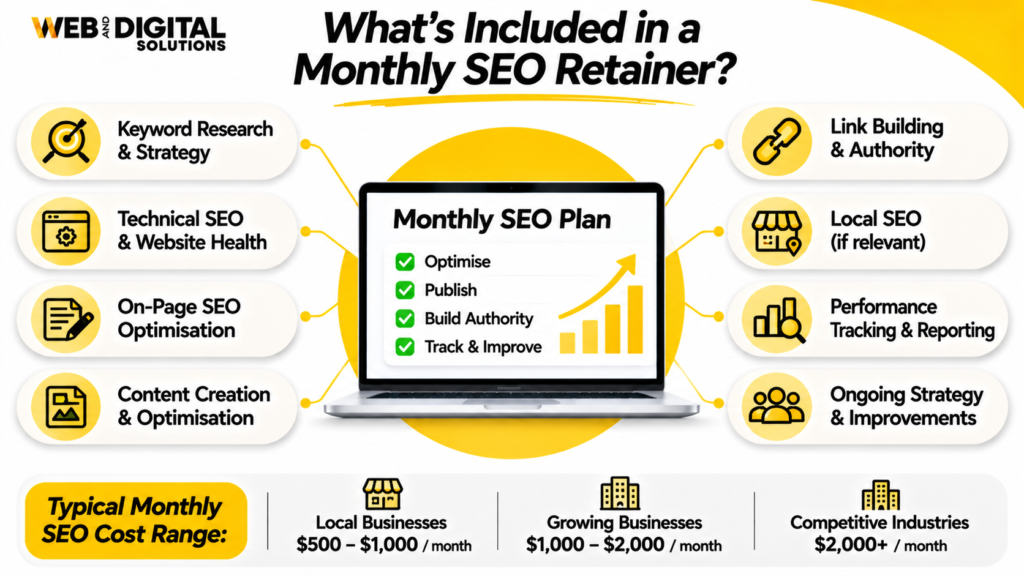
What Does a Monthly SEO Retainer Actually Include?
A monthly SEO retainer should represent a defined body of work, not simply a recurring payment for the promise of better rankings.
The exact deliverables vary by agency and campaign, but a well-planned SEO engagement may include the following areas.
1. Keyword Research and Strategy
Keyword research helps determine which searches are relevant to your products, services, and target audience.
An SEO agency should not simply select keywords with high search volume. It should identify terms that match your business objectives and the intent behind customer searches.
This work may include:
- Identifying primary and secondary keywords.
- Evaluating keyword competition.
- Reviewing search intent.
- Mapping keywords to relevant website pages.
- Identifying commercial and informational opportunities.
- Finding keyword gaps against competitors.
- Prioritising opportunities based on business value.
For example, a business offering commercial snow removal in London, Ontario, may benefit more from relevant service searches than from broad keywords about winter weather.
The purpose is to attract visitors who are more likely to need the services you provide.
2. Technical SEO and Website Maintenance
Technical SEO helps search engines access, crawl, and understand your website.
A monthly campaign may include ongoing technical monitoring and selected fixes based on the website’s requirements.
Common tasks include:
- Reviewing indexing and crawling issues.
- Checking robots.txt and XML sitemaps.
- Monitoring broken links and redirect errors.
- Reviewing canonical tags.
- Identifying duplicate or thin pages.
- Monitoring website performance.
- Reviewing mobile usability.
- Checking structured data implementation.
- Investigating technical changes that affect organic visibility.
Not every website needs a major technical overhaul every month. The agency should identify actual problems and prioritise fixes according to their potential impact.
For example, a website with incorrect canonical tags on important service pages may need immediate technical attention, while a technically healthy website may require only routine monitoring and smaller improvements.
3. On-Page SEO Optimisation
On-page SEO focuses on improving individual website pages so that their content and structure better satisfy relevant search queries.
Monthly on-page work may include:
- Optimising page titles and meta descriptions.
- Improving heading structures.
- Updating page content.
- Reviewing keyword placement naturally.
- Improving internal links.
- Optimising image descriptions and alt text.
- Improving calls to action.
- Reviewing page relevance and search intent.
A good agency should prioritise important commercial pages instead of making random changes across the website.
For example, improving a service page that attracts qualified enquiries may be more valuable than spending time updating a low-priority page with little business relevance.
4. Content Creation and Optimisation
Content is an important part of many SEO campaigns, particularly when a business needs to expand its search visibility and answer customer questions.
Depending on the agreement, monthly content work may include:
- New blog articles.
- Service page content.
- Location-specific landing pages.
- Supporting informational content.
- Content refreshes.
- Competitor content gap analysis.
- FAQ development.
- Content structure improvements.
However, the number of articles alone does not determine content quality.
A useful content plan should connect each article to a clear search intent and business objective.
For example, a local digital marketing agency could publish articles about SEO costs, technical audits, keyword research, and local search optimisation. These topics can support relevant service pages through contextual internal links.
Ask the agency whether content research, writing, editing, optimisation, and publishing are included in the retainer or billed separately.
5. Link Building and Off-Page SEO
Off-page SEO involves activities that help build a website’s reputation and authority beyond its own pages.
Depending on the campaign, monthly work may include:
- Identifying relevant link opportunities.
- Competitor backlink analysis.
- Digital PR outreach.
- Industry resource placements.
- Genuine business partnership opportunities.
- Brand mention monitoring.
- Evaluating existing backlink quality.
The objective should be to earn relevant and credible references, not simply increase the number of backlinks.
Be cautious of packages that promise hundreds of backlinks every month without explaining their sources, relevance, or quality.
A responsible agency should be able to explain its link acquisition approach and provide transparency about the work performed.
6. Local SEO and Google Business Profile Management
Local businesses may require additional SEO work to improve their visibility in geographically relevant searches.
Local SEO activities can include:
- Google Business Profile optimisation.
- Business category and service reviews.
- Business information consistency.
- Local keyword research.
- Location landing page optimisation.
- Local content development.
- Review monitoring and reputation guidance.
- Local citation analysis.
- Local competitor research.
For example, a business targeting customers in London, Ontario, may need a different local SEO strategy from a company targeting customers throughout Canada.
The agency should explain whether Google Business Profile management and local SEO activities are included in the monthly fee or treated as separate services.
7. Reporting, Analysis, and Campaign Planning
Reporting should explain what work was completed, what changed, and what the agency plans to improve next.
A monthly SEO report may cover:
- Keyword ranking trends.
- Google Search Console impressions and clicks.
- Organic website traffic.
- Landing page performance.
- Indexing developments.
- Technical issues identified and resolved.
- Content published or updated.
- Backlink activity.
- Leads and conversions, where tracking is available.
- Priorities for the next reporting period.
A report should not simply contain screenshots and ranking tables.
It should connect SEO activity to performance and explain what the data means for the business.
Why Do Monthly SEO Prices Vary Between Agencies?
Two agencies may quote different monthly fees for what appears to be the same SEO service.
The difference often comes down to campaign scope, resources, expertise, and implementation requirements.
Here are the main factors that influence monthly SEO pricing.
1. Website Size and Complexity
A small business website with five service pages generally requires a different level of work from an ecommerce website with hundreds of product and category pages.
Larger websites may need more time for:
- Technical audits.
- Page-level optimisation.
- Duplicate content investigation.
- Internal linking improvements.
- Content management.
- Indexing reviews.
- Ecommerce SEO analysis.
The number of URLs is not the only consideration. Website structure and technical complexity also influence the workload.
2. Industry and Keyword Competition
A business operating in a competitive market may require more extensive research, content development, and authority-building activities.
For example, competing for a highly specific local service keyword may require a different campaign from competing for a broad national commercial keyword.
An agency should evaluate the actual search results and competitors before recommending a monthly scope.
3. Number of Target Locations
A business serving one city may need a relatively focused local SEO campaign.
A company targeting multiple cities or regions may require additional work, such as:
- Location-specific keyword research.
- Separate landing pages.
- Local competitor analysis.
- Geographic content planning.
- Google Business Profile strategy, where applicable.
- Internal linking between location and service pages.
However, creating multiple location pages without meaningful local information can result in repetitive, low-value content. The strategy should prioritise genuinely useful pages.
4. Content Requirements
Some campaigns need only occasional content improvements, while others require a consistent publishing programme.
The monthly workload may increase when the strategy includes:
- Multiple long-form articles.
- New service pages.
- Product descriptions.
- Location landing pages.
- Existing content updates.
- Subject-matter research and editing.
Always clarify how many content pieces are included and what level of research and optimisation they receive.
5. Technical Work and Development Requirements
Some SEO tasks can be completed directly through a content management system, while others require developer involvement.
For example, correcting a title tag is usually straightforward. Fixing complex rendering issues, restructuring URLs, or implementing changes across a large ecommerce website may require additional technical resources.
Ask whether development work is included in the retainer or charged separately.
6. Agency Expertise and Team Structure
An SEO retainer may involve several specialists, including:
- SEO strategists.
- Technical SEO specialists.
- Content writers and editors.
- Link-building specialists.
- Developers.
- Analytics and reporting professionals.
- Account or project managers.
The structure varies by provider. An agency with specialist resources may offer a different service model from an individual consultant.
The important consideration is whether the people responsible for the work have the skills and capacity required by your campaign.
What Should Different Monthly SEO Packages Include?
SEO packages should be designed around business requirements rather than arbitrary deliverable counts.
The following comparison shows how campaign scope may differ. It is an illustrative service structure, not a universal industry standard.
| Campaign area | Basic local SEO | Growth SEO | Advanced SEO |
|---|---|---|---|
| Initial SEO audit | Core website review | Detailed SEO audit | Comprehensive technical and competitive review |
| Keyword research | Core local keywords | Expanded keyword mapping | Broad keyword and market analysis |
| On-page SEO | Priority pages | Ongoing page optimisation | Larger-scale page optimisation |
| Technical SEO | Essential issue monitoring | Regular technical reviews | Deeper technical analysis and coordination |
| Content | Selected content updates | Regular content development | Larger content strategy and production |
| Link building | Limited opportunities | Ongoing relevant outreach | Broader authority-building strategy |
| Local SEO | Core local optimisation | Expanded local campaign | Multi-location or complex local strategy |
| Reporting | Monthly summary | Detailed monthly reporting | Performance analysis and strategic reviews |
| Best suited for | Smaller local websites | Businesses seeking consistent growth | Larger or more competitive campaigns |
A package labelled “advanced” does not automatically make it better for every business. The right option depends on your current website condition, competitive environment, and available resources.
How to Evaluate an SEO Proposal Before Hiring an Agency
A professional SEO proposal should explain what the agency plans to do, why those activities matter, and how performance will be evaluated.
Before accepting a monthly retainer, ask these questions.
1. What Exactly Is Included in the Monthly Fee?
Ask for a clear breakdown of the services included.
For example:
- How many pages will be optimised?
- Is content writing included?
- How many content pieces are planned?
- Is technical SEO included?
- Does the agency handle implementation?
- Are backlinks included?
- Is local SEO part of the campaign?
- Are reporting and strategy meetings included?
Avoid accepting vague descriptions such as “complete SEO” without a defined scope.
2. Who Will Actually Work on My Website?
Find out whether the agency has an in-house team, uses external contractors, or assigns different specialists to different tasks.
You should understand who is responsible for strategy, content, technical work, and communication.
3. How Will SEO Performance Be Measured?
Ask which metrics will be used to evaluate campaign performance.
A useful reporting structure should consider:
- Organic impressions and clicks.
- Target keyword performance.
- Organic landing page traffic.
- Relevant leads and enquiries.
- Conversion tracking.
- Technical improvements.
The agency should explain how these metrics connect to your business goals.
4. Will I Receive a Monthly Work Report?
You should be able to see what was completed during the reporting period.
A useful report should distinguish between:
- Completed activities.
- Work currently in progress.
- Issues that require approval or development support.
- Planned activities.
- Performance changes.
- Priorities for the next month.
This makes it easier to understand what you are paying for.
5. Are There Additional Costs?
Some agencies quote a monthly retainer but charge separately for services such as:
- Website development.
- Premium SEO tools.
- Content production.
- Digital PR campaigns.
- Paid directories or placements.
- Website hosting.
- Conversion rate optimisation.
- Website redesigns.
Ask for these costs to be clarified before signing an agreement.
6. What Happens If the Campaign Does Not Perform as Expected?
SEO outcomes cannot be guaranteed, but an agency should have a clear process for evaluating underperformance.
Ask how it will investigate declining traffic, stagnant rankings, technical problems, or low conversion rates.
The answer should involve data analysis and adjustments to the strategy, not simply a promise to continue doing the same work.
Red Flags to Watch for When Comparing SEO Packages
A low monthly fee is not necessarily a problem. The risk comes when the agency cannot explain what it will deliver or how it intends to improve your website.
Watch for these warning signs:
- Guaranteed rankings: No agency can reliably guarantee specific Google positions or deadlines.
- Unclear deliverables: The proposal lists SEO activities without specifying what will actually be completed.
- Bulk backlink promises: Large backlink quantities are offered without explaining relevance or quality.
- Automated content production: Articles are produced at scale without meaningful research, editing, or quality control.
- No technical assessment: The agency recommends a package without understanding your website.
- No conversion tracking: The campaign focuses entirely on rankings without considering leads or enquiries.
- No transparent reporting: You cannot see what work was completed or what changed.
- Long commitments without accountability: The contract does not clearly explain scope, reporting, ownership, or cancellation terms.
A reliable SEO provider should be able to explain its approach in plain language and support its recommendations with evidence.
Should You Choose a Cheap SEO Package or Invest in a Larger Campaign?
The cheapest package is not always the most cost-effective option.
If your website has major technical problems, a package focused mainly on blog publishing may not address the issues preventing important pages from performing.
Similarly, if your website is technically healthy but lacks useful content, spending most of the budget on technical monitoring may not be the best use of resources.
Before choosing a package, consider:
- What is currently preventing your website from attracting organic traffic?
- Which services and locations are most valuable to your business?
- How competitive are the keywords you want to target?
- What work needs to be completed each month?
- Can the agency demonstrate how its work will be evaluated?
The goal should be to invest in the activities that address your website’s actual needs.
Is a Monthly SEO Retainer Worth It for a Small Business?
A monthly SEO retainer can be worthwhile when your business depends on online discovery and needs ongoing support to improve organic visibility.
It may be a suitable option if:
- Your website is not attracting enough qualified organic traffic.
- Your competitors are gaining visibility for valuable search terms.
- Your business serves customers in a defined local area.
- Your website needs regular content and technical improvements.
- You want a consistent SEO strategy rather than occasional fixes.
- You have a long-term plan to generate enquiries through organic search.
However, not every business needs a large monthly campaign from the beginning.
A smaller business with a limited website may benefit from an initial audit and a focused set of improvements before moving into a broader ongoing retainer.
The right investment should reflect the work required and the potential business value, not simply the size of the package.
How Web & Digital Solutions Approaches Monthly SEO Campaigns
At Web & Digital Solutions, we believe an SEO campaign should be based on a website’s actual requirements, business objectives, and competitive environment.
Rather than treating every business as if it needs the same package, the campaign should identify where improvements are needed and prioritise the work accordingly.
Our SEO services can include:
- SEO audits: Identifying technical, on-page, and content-related opportunities.
- Keyword research: Finding relevant search terms based on search intent and business value.
- On-page optimisation: Improving important website pages and their search relevance.
- Technical SEO: Addressing crawling, indexing, website structure, and performance issues.
- Content strategy: Planning useful articles and service content around customer searches.
- Link building: Identifying relevant opportunities to strengthen website authority.
- Local SEO: Improving visibility for businesses serving London, Ontario, and surrounding areas.
- Performance reporting: Monitoring organic visibility, traffic, and meaningful business outcomes.
If you are comparing SEO agencies, start by understanding what your website needs and what work should be included in your monthly campaign.
Explore our SEO services in London, Ontario to learn more about our approach.
You can also contact Web & Digital Solutions to discuss your website and SEO requirements.
Frequently Asked Questions About Monthly SEO Costs
1. How much does SEO cost per month for a small business?
Monthly SEO costs for a small business depend on its website size, target locations, keyword competition, and required services. A focused local campaign may require a different level of investment from a business targeting multiple regions or highly competitive keywords. Request a proposal with clearly defined deliverables.
2. What is included in a monthly SEO package?
A monthly SEO package may include keyword research, technical SEO, on-page optimisation, content development, link building, local SEO, performance monitoring, and reporting. The exact services depend on the agreement, so businesses should confirm which activities are included before signing.
3. Is monthly SEO better than one-time SEO?
Monthly SEO is generally more suitable for businesses that need continuous optimisation, content development, performance monitoring, and competitive analysis. One-time SEO projects can be useful for specific requirements such as technical audits, website migrations, or initial website optimisation.
4. Why do SEO agencies charge different monthly fees?
SEO agencies charge different fees because campaign scope, website complexity, industry competition, team expertise, content requirements, and technical workload vary. A higher fee may reflect a broader scope of work, but businesses should evaluate actual deliverables rather than assuming price indicates quality.
5. Should content writing be included in monthly SEO pricing?
Content writing may be included in a monthly SEO retainer, but this depends on the agency’s package. Businesses should confirm how many articles or pages are included, who writes them, whether research and editing are covered, and whether content publishing and optimisation are part of the agreement.
6. How long should I commit to an SEO agency?
The appropriate commitment depends on the website’s condition, campaign scope, and business objectives. SEO often requires sustained work over several months, but businesses should review the contract terms, deliverables, reporting process, and cancellation conditions before making a commitment.
7. How can I tell if my monthly SEO investment is working?
Evaluate SEO performance through organic impressions, clicks, keyword visibility, landing page traffic, qualified enquiries, and conversions. Monthly reports should explain completed work, performance changes, outstanding issues, and the next steps. Rankings alone do not provide a complete picture of campaign success.