Choosing the right SEO keywords is one of the most important steps in building a website that attracts relevant organic traffic. The keywords you target influence which searches your pages may appear for, what kind of visitors discover your business, and whether those visitors find services or information that match their needs.
However, keyword research is not simply about finding phrases with high search volumes. A keyword that attracts thousands of searches may generate little business value if the people searching for it are looking for something you do not offer. Meanwhile, a more specific phrase with fewer searches may connect your website with people who are actively comparing services or looking for a provider.
The goal is to build an SEO keyword strategy around search intent, business relevance, commercial value, and the purpose of each website page.
In this guide, you will learn how to choose SEO keywords for your business website, evaluate keyword opportunities, map terms to the right pages, and avoid common keyword research mistakes.
Why Choosing the Right SEO Keywords Matters
SEO keywords help search engines understand the subject of a page and help businesses identify the topics their audiences are searching for. When selected strategically, they can guide website structure, content planning, service page optimisation, and internal linking.
For example, a digital marketing agency may target broad terms such as “digital marketing” and “SEO.” However, these phrases do not always communicate a specific service requirement or location.
More specific searches, such as “SEO services in London Ontario” or “local SEO for small businesses,” may better reflect what a potential customer needs.
Effective keyword selection helps your business:
- Attract visitors who are relevant to your products or services.
- Align website content with what searchers actually want.
- Identify opportunities for new service pages and supporting blog content.
- Improve the relevance of existing pages.
- Build a clearer SEO strategy around measurable business goals.
Keyword research should therefore begin with your business objectives rather than a list of popular search terms.
1. Start With Your Business Goals and Services
Before opening a keyword research tool, identify what your business wants to achieve through organic search.
Are you trying to generate enquiries, sell products, promote a professional service, build brand awareness, or educate potential customers? Your answer will influence which keywords deserve priority.
Start by listing your main offerings, the problems they solve, and the customers most likely to need them.
For example, a web design agency might organise its services into:
- Website design and development
- Search engine optimisation
- Local SEO
- Content marketing
- Website performance optimisation
Each service represents a potential keyword group. The next step is to identify the language customers use when searching for those solutions.
Do not assume that the terms used internally by your business are the same terms your customers use. Keyword research should validate those assumptions with actual search data wherever possible.
2. Understand Search Intent Before Comparing Search Volume
Search intent refers to the purpose behind a search query. Understanding intent helps you determine what type of page is most appropriate for a keyword.
There are four commonly used intent categories.
Informational intent
The searcher wants to learn something, understand a problem, or find instructions.
Examples:
- How to choose SEO keywords
- What is technical SEO?
- How does keyword research work?
Best content format: Educational blog posts, guides, tutorials, and explanatory resources.
Commercial investigation intent
The searcher is researching solutions before making a decision. They may compare providers, features, approaches, or prices.
Examples:
- Best SEO agency for small businesses
- SEO services comparison
- How much does SEO cost in Canada?
Best content format: Comparison articles, pricing guides, case studies, and detailed service information.
Transactional intent
The searcher is closer to taking an action, such as purchasing a product, booking a service, or requesting a quote.
Examples:
- Hire an SEO agency
- Book website design services
- Buy commercial irrigation equipment
Best content format: Service pages, product pages, booking pages, and conversion-focused landing pages.
Navigational intent
The searcher wants to find a particular brand, website, or destination.
Examples:
- Web & Digital Solutions
- Google Search Console login
Best content format: Relevant brand pages or the specific destination being searched for.
A single keyword can sometimes have mixed intent. Review the current search results to understand what Google is showing and what users are likely expecting.
3. Build a Keyword List Around Your Core Topics
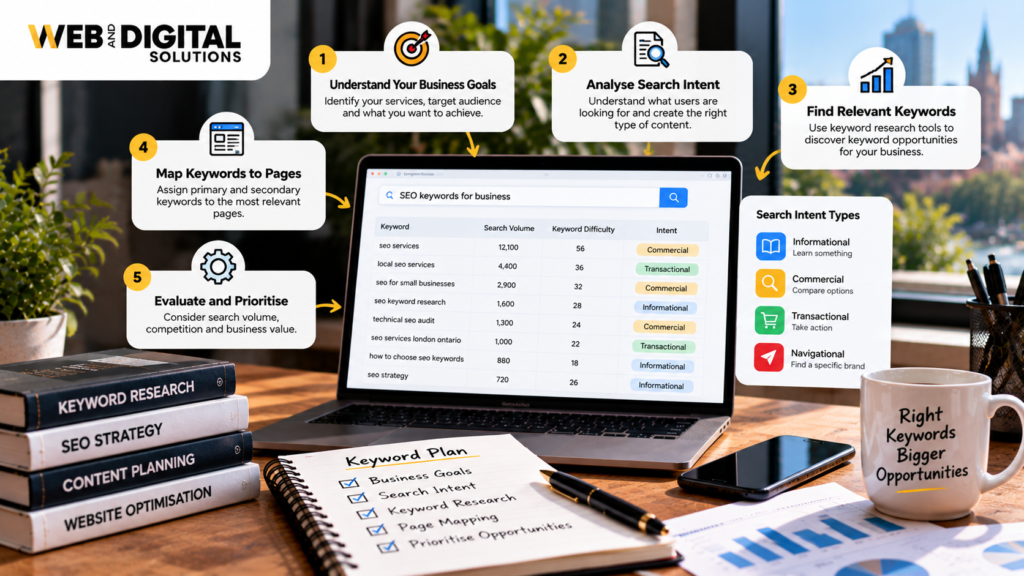
Once you understand your business goals and search intent, create an initial list of keywords related to your services, products, customers, and industry.
Start with your main service categories. Then expand each topic into related searches, specific needs, questions, and location-based variations where relevant.
For example, a business offering SEO services might investigate:
- SEO services
- SEO services for small businesses
- Local SEO services
- SEO keyword research
- Technical SEO audit
- SEO pricing in Canada
- How to choose an SEO agency
These terms represent different needs and may require different pages.
You can use tools such as Google Keyword Planner, Google Search Console, Semrush, and Ahrefs to discover keyword ideas and review available search data. Customer enquiries, sales conversations, and frequently asked questions can also reveal useful language and topics.
At this stage, collect relevant possibilities rather than immediately choosing a winner. You can evaluate and prioritise them once the initial list is complete.
4. Evaluate Search Volume, Competition, and Business Relevance
Search volume is useful, but it should not be the only factor in keyword selection. A practical keyword evaluation considers several signals together.
| Factor | What to evaluate |
|---|---|
| Search volume | How often people search for the term, based on available estimates |
| Competition or difficulty | How challenging it may be to compete for visibility |
| Business relevance | How closely the query relates to your actual offering |
| Search intent | Whether the searcher’s goal matches the page you plan to create |
| Commercial value | Whether the search may support enquiries, sales, or another business objective |
| Current visibility | Whether your website already receives impressions or clicks for the term |
A high-volume keyword may be too broad to prioritise, while a lower-volume keyword may attract a more relevant audience. Neither outcome should be assumed without considering the evidence.
For example, a company selling business website services should not automatically prioritise a broad term such as “websites” simply because it has a large audience. A more specific phrase describing business website design may better match the company’s services.
Likewise, keyword difficulty scores from third-party tools are estimates, not guarantees of ranking success.
5. Identify Commercial Keywords That Support Business Growth
Commercial keywords are search terms that indicate a potential interest in evaluating, selecting, or purchasing a solution.
For service businesses, these may include phrases containing terms such as:
- Services
- Agency
- Company
- Consultant
- Pricing
- Cost
- Packages
- Near me
- Hire
The value of these modifiers depends on the industry and the actual search intent. For example, someone searching for “SEO agency pricing” may be comparing providers, while someone searching for “how SEO works” is more likely looking for an explanation.
Commercial keywords often deserve dedicated attention because they can connect your website with users evaluating solutions. However, they should not replace informational content. Educational blogs can answer early-stage questions and help users discover your expertise before they are ready to contact a provider.
The strongest keyword strategy balances the needs of visitors at different stages of their decision-making process.
6. Map Each Primary Keyword to the Right Website Page
Keyword mapping means assigning a primary keyword and relevant supporting terms to the most appropriate page on your website.
This step helps prevent multiple pages from competing unnecessarily for the same search intent. It also gives every important page a clear purpose.
For example, a digital marketing agency could organise its keyword mapping like this:
| Page type | Primary keyword example | Supporting terms |
|---|---|---|
| SEO service page | SEO services London Ontario | SEO agency, professional SEO services |
| Local SEO service page | Local SEO London Ontario | Google Business Profile optimisation, local search visibility |
| Blog article | How to choose SEO keywords | Keyword research for business, keyword search intent |
| Pricing blog | How much does SEO cost in Canada? | SEO pricing Canada, monthly SEO packages |
The primary keyword should reflect the main purpose of the page, while supporting terms should fit naturally into the content.
Do not create a separate page for every minor keyword variation. If several terms have similar intent and can be addressed effectively by one page, consolidating them may provide a clearer experience for visitors.
Use internal links to connect related content. For example, an educational article about keyword selection can link to your SEO services page when readers want to understand how professional SEO support may help their business.
7. Prioritise Keywords Instead of Targeting Everything at Once
A keyword list can quickly become overwhelming. Prioritisation helps you focus on the opportunities most closely aligned with your business goals and current website capabilities.
Consider the following approach:
First, address high-relevance service keywords. Review whether your main service pages clearly target the terms customers use to find those services.
Next, improve existing opportunities. Use Google Search Console to identify queries generating impressions but receiving relatively few clicks, or relevant queries for which your pages have visibility that could potentially be improved. Investigate the page, search intent, title, content, and ranking position before deciding what to change.
Then, develop supporting informational content. Publish useful articles that answer related questions and connect readers with relevant service pages.
Finally, assess competitive opportunities. Consider whether your website has the expertise, content quality, technical foundations, and resources needed to compete for more difficult keywords.
A simple prioritisation scorecard can help your team compare opportunities consistently. Rate relevance, intent alignment, commercial value, and ranking feasibility from 1 to 5. Treat the scores as an internal decision-making aid, not a prediction of Google rankings.
8. Check the Search Results Before Finalising Your Keywords
Keyword tools provide useful data, but the search results help reveal what Google currently considers relevant to a query.
Search your shortlisted terms and review:
- The types of pages ranking on the first page.
- Whether results are primarily informational articles, service pages, product pages, or local listings.
- The topics and questions covered by competing pages.
- Whether location-specific results appear.
- The level of detail users may expect from the content.
Suppose you plan to target “how to choose SEO keywords.” If the results primarily feature step-by-step educational guides, a direct service landing page may not satisfy the intent as effectively as a detailed blog post.
Search results can change, so use this review as a snapshot rather than a permanent rule. Your goal is to create the most useful page for the intended audience, not simply imitate competing content.
9. Avoid These Common SEO Keyword Research Mistakes
Even a large keyword list will not produce a strong strategy if the selection and implementation are flawed.
Choosing keywords only because they have high volume
High search volume does not automatically mean high business value. Consider relevance, intent, competition, and the audience you can realistically serve.
Ignoring search intent
A blog post and a service page serve different purposes. Select the content format that matches what searchers are trying to accomplish.
Stuffing keywords into content
Repeatedly inserting an exact phrase can make content unnatural and difficult to read. Use the primary keyword where relevant and include related terminology naturally.
Targeting the same intent across multiple pages
Several pages built around nearly identical keywords may overlap in purpose. Review existing content before creating another page, and consolidate or differentiate pages where appropriate.
Ignoring existing performance data
Your website may already receive impressions for relevant terms that were not included in the original research. Review Search Console data regularly to uncover opportunities.
Treating keyword research as a one-time task
Customer needs, competitors, search results, and business priorities evolve. Review your keyword strategy periodically and update it when the evidence supports a change.
10. Measure Results and Refine Your Keyword Strategy
After publishing or optimising pages, monitor performance to understand whether your keyword choices are supporting your objectives.
Google Search Console can help you review impressions, clicks, click-through rate, average position, and the queries associated with individual pages. Google Analytics 4 can help you investigate what visitors do after arriving on your website, including whether they engage with important pages or complete tracked conversions.
Review performance by page and query rather than judging success through one ranking position alone. A keyword may improve visibility without producing meaningful enquiries, while a less prominent query may attract visitors who are more likely to convert.
Use the findings to refine titles, improve content, strengthen internal links, address technical problems, or reconsider whether a page matches its intended search intent.
Avoid changing content simply because rankings fluctuate over a short period. Evaluate trends, the significance of the change, and any relevant technical or search-result developments before deciding on the next action.
Build a Keyword Strategy Around the Right Audience
Learning how to choose SEO keywords is about more than finding popular phrases. It requires understanding your business objectives, identifying what searchers want, evaluating commercial relevance, and assigning keywords to pages that meet those needs.
A practical process starts with your services, expands into relevant keyword ideas, evaluates search intent and competition, and maps each priority term to the right page. Ongoing performance monitoring then helps you identify what is working and where improvements may be needed.
At Web & Digital Solutions, we believe keyword research should support a broader digital marketing strategy—not exist as a spreadsheet disconnected from business goals. A well-planned SEO strategy connects useful content, relevant service pages, technical website performance, and meaningful measurement.
If your website attracts visitors but struggles to reach the right audience, reviewing your keyword targeting can be a useful starting point. Explore our SEO services to learn how a structured approach to search optimisation can support your website’s organic visibility and long-term growth.
Frequently Asked Questions About Choosing SEO Keywords
1. How do I choose the right SEO keywords for my business?
Start by identifying your products or services, target audience, and business goals. Research relevant search terms, evaluate intent, volume, competition, and commercial value, then assign each primary keyword to the most appropriate website page.
2. Should I choose keywords with high search volume?
Not necessarily. High-volume keywords can attract broad audiences, but they may be highly competitive or poorly aligned with your services. Consider relevance, intent, competition, and potential business value alongside search volume.
3. What is the difference between primary and secondary keywords?
A primary keyword represents the main search topic a page is designed to address. Secondary keywords are closely related terms, variations, or subtopics that help the page cover the subject naturally and comprehensively.
4. How many keywords should I target on one page?
There is no fixed number. Focus on one clear primary topic and include relevant secondary terms where they fit naturally. The page should satisfy a specific search intent rather than attempt to target an arbitrary number of keywords.
5. What are commercial keywords?
Commercial keywords indicate that a searcher may be evaluating products or services before making a decision. Examples can include phrases containing “best,” “pricing,” “cost,” “agency,” or “services,” depending on the context and intent.
6. Which tools can help with keyword research?
Google Keyword Planner, Google Search Console, Semrush, and Ahrefs can help discover keyword ideas and evaluate available data. Reviewing search results and listening to customer questions can provide additional context that tools alone may not reveal.
7. How often should I update my SEO keyword strategy?
Review performance regularly, such as monthly, and conduct a more detailed assessment quarterly or when business priorities change. Use actual performance data and changes in search intent to decide when updates are necessary.