SEO Services in London, Ontario: 7 Ways to Get Found on Google and Win More Customers
When potential customers search Google for a product or service in London, Ontario, businesses that appear prominently in relevant search results have an opportunity to earn their attention. But having a website alone does not guarantee visibility. Your website needs to communicate what you offer, target the right searches and provide a useful experience for visitors.
This is where SEO services in London, Ontario, can help. Search engine optimisation improves the elements of your website that influence its ability to appear in relevant organic search results. For local businesses, a well-planned SEO strategy can help attract qualified traffic, strengthen online visibility and create more opportunities for enquiries.
Whether you operate a small business, a professional service company or an established organisation, understanding the fundamentals of SEO can help you make better marketing decisions.
Why SEO Matters for Businesses in London, Ontario
Customers often research businesses online before deciding whom to contact. They may compare services, review websites, check business information or search for providers in their area.
If your website does not appear for relevant searches, potential customers may discover competing businesses instead.
Investing in SEO in London, Ontario, can help your business improve its organic visibility by making its website more relevant, accessible and useful to both search engines and users.
A well-planned strategy can support several objectives:
- Increase organic visibility: Improve your website’s opportunity to appear for searches relevant to your services.
- Attract qualified visitors: Reach people who are actively researching or looking for what your business offers.
- Strengthen local presence: Help search engines understand your services and the locations you serve.
- Improve website usability: Make important information, service details and contact options easier to find.
- Support long-term growth: Build an organic marketing channel through ongoing optimisation and useful content.
SEO does not guarantee rankings or a fixed number of leads. Performance depends on competition, website condition, search demand, implementation quality and other factors.
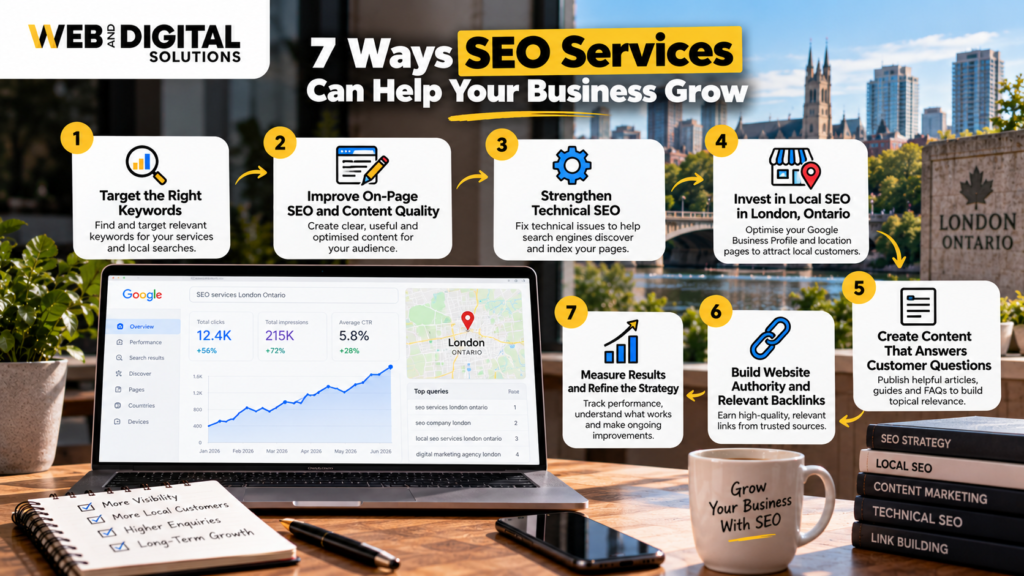
7 Ways SEO Services Can Help Your Business Grow
1. Target the Right Keywords for Your Services
Keyword research identifies the terms people use when searching for businesses, products and services. Choosing relevant keywords helps you create pages that match what potential customers want to find.
For example, a business targeting London, Ontario, may need different pages for its main services, specific offerings and location-based searches.
A keyword strategy should consider search intent as well as search volume. Someone searching for an SEO agency may be ready to compare providers, while someone searching for SEO advice may need an educational article.
An experienced SEO agency in London, Ontario, should map primary and secondary keywords to appropriate pages rather than targeting every keyword on a single page.
This approach helps reduce keyword overlap and gives each important page a clear purpose.
2. Improve On-Page SEO and Content Quality
On-page SEO helps search engines understand what a page covers and helps visitors find relevant information.
Common optimisation tasks include:
- Writing descriptive title tags and meta descriptions.
- Organising content with clear headings.
- Improving service-page copy and calls to action.
- Optimising images and descriptive alt text.
- Adding relevant internal links.
- Making page content more useful and specific to the audience.
For businesses investing in SEO services, the goal should not be to insert keywords into every paragraph. Instead, each page should answer the visitor’s questions, explain the service clearly and provide a logical next step.
Content should be written for the intended customer first, with keywords integrated naturally where they help communicate the topic.
3. Strengthen Technical SEO
Technical SEO addresses issues that can prevent search engines from discovering, understanding or indexing important website pages.
Depending on your website, an audit may review crawlability, indexing, redirects, broken links, canonical tags, XML sitemaps, mobile usability and page performance.
For example, a valuable service page may receive little organic visibility if it is accidentally blocked from indexing or disconnected from the website’s internal link structure.
Technical SEO should be prioritised according to the actual impact of each issue. Not every warning reported by an SEO tool requires immediate action.
A structured technical review helps identify problems that matter and creates a practical roadmap for improving the website.
4. Invest in Local SEO in London, Ontario
Local SEO helps businesses improve their visibility for searches with a geographic or local-service intent.
For eligible businesses, this may include Google Business Profile optimisation, accurate business information, relevant service categories, genuine customer reviews and consistent contact details.
Your website should also clearly explain your services and the areas you genuinely serve. Relevant local landing pages can help customers understand whether your business is appropriate for their needs.
Local SEO is particularly important when people search phrases such as “SEO company near me” or “local SEO services near me.” These searches suggest that users are looking for a relevant provider, often with a geographic preference.
However, appearing in local results is not guaranteed. Google’s local results can be influenced by relevance, distance and prominence, among other factors.
For businesses targeting London, Ontario, local optimisation should connect accurate location information with useful service pages and a consistent customer experience.
5. Create Content That Answers Customer Questions
Content marketing helps your website address questions people ask before choosing a provider.
Useful content may include service explanations, comparison guides, practical advice, frequently asked questions and industry-specific resources.
For example, an SEO services page can explain what an agency offers, while supporting blog articles can answer questions about SEO costs, local rankings, technical audits and campaign reporting.
Each article should have a defined purpose and link naturally to a relevant service page when it helps the reader.
Publishing more content is not automatically better. Content should add genuine value, address a relevant search intent and avoid duplicating existing pages without a clear reason.
A focused content strategy can help businesses build topical relevance and create more entry points through organic search.
6. Build Website Authority and Relevant Backlinks
Backlinks are links from other websites to yours. Relevant, credible links can help search engines discover pages and understand relationships between websites.
A responsible link-building strategy focuses on earning useful mentions through legitimate business relationships, relevant industry contributions, valuable resources and appropriate local directories.
The quality and relevance of links matter more than simply accumulating large numbers.
Avoid schemes that promise hundreds of backlinks or guaranteed rankings through artificial link-building practices. These approaches can create unnecessary risk and may fail to support sustainable organic performance.
A good SEO strategy considers link acquisition alongside technical improvements, content quality and the overall relevance of the website.
7. Measure Results and Refine the Strategy
SEO should be evaluated against meaningful business objectives, not just the number of keywords tracked or pages published.
Useful performance indicators include:
- Organic clicks and impressions.
- Rankings for relevant target queries.
- Click-through rate from search results.
- Performance of important landing pages.
- Qualified enquiries and tracked conversions.
- Local visibility for relevant service searches.
Google Search Console can help measure search visibility and clicks. Analytics and properly configured conversion tracking can provide additional insight into how visitors interact with your website.
Regular reporting helps identify what is improving, which pages need attention and where the next optimisation effort may be most valuable.
SEO Agency vs. Doing SEO Yourself
Some business owners manage basic SEO themselves, particularly when they have a small website and time to learn the necessary tools. Others work with an SEO agency to access specialised expertise and ongoing implementation support.
| Consideration | DIY SEO | SEO agency |
|---|---|---|
| Initial investment | Primarily time and tools | Service fees plus any additional costs |
| Expertise | Built through learning and practice | Access to the agency’s relevant experience |
| Implementation | Depends on your available time | Depends on the agreed scope and resources |
| Strategy | Self-managed | Developed collaboratively with the provider |
| Reporting | Set up and interpreted internally | May include reporting and recommendations |
Neither approach is right for every business. Your choice depends on your budget, technical knowledge, available time and the complexity of your website.
When evaluating a digital marketing agency in London, Ontario, ask for a clear explanation of its strategy, deliverables, implementation responsibilities and reporting process.
A suitable provider should understand your business objectives and explain how the proposed work supports them.
How to Choose an SEO Company in London, Ontario
Choosing an SEO company involves more than comparing monthly prices or promises about rankings.
Before selecting a provider, consider the following:
Understand the proposed scope. Ask whether the package includes keyword research, technical SEO, content optimisation, local SEO, link acquisition and reporting.
Look for a strategy tailored to your business. Your industry, target audience, website condition and competition should influence the recommendations.
Review reporting practices. Reports should explain completed work, performance changes and upcoming priorities in understandable terms.
Ask about communication. Clarify how often progress is reviewed, who approves content and how implementation tasks are handled.
Avoid guaranteed ranking claims. No agency can guarantee a particular Google position or a fixed number of leads through SEO alone.
The right partner should be transparent about the work required, the limitations of SEO and the metrics used to evaluate progress.
SEO vs. Paid Advertising: Which Is Better?
SEO and paid advertising can support different stages of your marketing strategy.
SEO aims to improve organic visibility through relevant content, technical optimisation and website improvements. It can build long-term value, but competitive searches may require sustained work before meaningful gains appear.
Paid advertising can provide visibility for selected searches while campaigns are active. It requires an advertising budget and ongoing management, and traffic generally declines when campaigns stop unless other channels continue generating visitors.
Some businesses benefit from using both approaches. Paid advertising may support immediate campaign objectives, while SEO builds organic visibility over time.
The appropriate balance depends on your budget, competition, customer acquisition goals and how quickly you need results.
Get Started with SEO Services in London, Ontario
Improving organic visibility requires more than adding keywords to a website. Businesses need relevant content, a technically sound website, a clear local presence and ongoing evaluation of what is working.
Web & Digital Solutions helps businesses approach their online presence with a focus on relevant search visibility, useful website content and measurable marketing objectives.
If you are exploring SEO services in London, Ontario, start by identifying your most important services, understanding how customers search for them and reviewing your website’s current performance.
Visit Web & Digital Solutions to learn more about the business and explore its SEO services in London, Ontario.
A well-planned SEO strategy can help create a stronger foundation for organic growth, more relevant website visits and future customer enquiries.
Frequently Asked Questions
1. How much do SEO services cost in London, Ontario?
SEO costs vary according to the website’s condition, competition, campaign scope and level of ongoing work. Packages may include different combinations of technical SEO, content optimisation, local SEO and link acquisition. Request a proposal that clearly defines the deliverables and reporting.
2. How long does SEO take to show results?
SEO timelines vary. Some technical and on-page improvements may be reflected relatively quickly, while competitive keywords and broader organic growth can take considerably longer. Results depend on the website’s starting point, competition, implementation quality and ongoing effort.
3. How do I choose an SEO agency in London, Ontario?
Look for an agency that understands your business, explains its strategy, defines deliverables, reports meaningful metrics and avoids guaranteed ranking claims. Compare proposals based on the work involved and your business objectives rather than price alone.
4. What is the difference between local SEO and traditional SEO?
Traditional SEO focuses on improving a website’s visibility in organic search results more broadly. Local SEO places additional emphasis on location-related searches, business information, Google Business Profile optimisation where applicable and visibility in relevant local results.
5. Can SEO help a small business attract more local customers?
Yes. SEO can help small businesses become more visible for relevant searches and direct potential customers to useful service pages. Actual enquiries depend on demand, competition, website experience, service relevance and conversion tracking.
6. Is SEO better than paid advertising?
Neither is universally better. SEO can build organic visibility over time, while paid advertising can provide targeted visibility during a campaign. The right choice depends on business objectives, budget, competition and the time available to achieve results.