If you run a small business in Ontario, investing in digital marketing comes with an important question: should you focus on SEO, Google Ads, or both?
You want your business to appear when potential customers search for your services. You also want your marketing budget to generate qualified enquiries, sales and measurable returns. However, SEO and Google Ads work differently, and choosing the wrong approach for your current goals can lead to unrealistic expectations or inefficient spending.
SEO focuses on improving your website’s visibility in organic search results. Google Ads allows you to pay for advertising placements to reach relevant searchers. One can help build long-term organic visibility, while the other can provide paid exposure soon after a campaign launches.
Neither channel guarantees leads or sales. The right strategy depends on your budget, competition, business goals, website quality and how quickly you need results.
In this guide, we compare SEO vs Google Ads for small businesses in Ontario and explain when each channel makes sense.
What Is SEO?
Search engine optimisation (SEO) is the process of improving a website’s visibility in organic search results.
When potential customers search for services related to your business, SEO helps your website become more relevant and accessible to search engines and users.
A typical SEO strategy may include:
- Keyword research and search intent analysis
- Technical SEO audits and improvements
- Service-page optimisation
- Content creation and updates
- Internal linking and website structure improvements
- Local SEO and Google Business Profile optimisation
- Relevant authority and backlink development
- Performance monitoring and ongoing refinement
For example, a landscaping company serving London, Ontario, may want its website to appear for relevant searches related to landscaping, lawn care or outdoor lighting services.
SEO can help the business develop organic visibility for these searches. However, rankings depend on multiple factors, including competition, website quality, search intent and ongoing changes in search results.
The main advantage of SEO is its potential to build an ongoing source of relevant organic traffic without paying an advertising fee for each organic click.
What Is Google Ads?
Google Ads is Google’s online advertising platform. Businesses can use it to display ads across eligible Google advertising placements, including search results.
With Search campaigns, advertisers can target relevant search themes, set budgets, choose geographic targeting and direct visitors to specific landing pages.
For example, a plumbing company in Ontario may run a campaign targeting searches from people looking for plumbing repairs in its service area.
Google Ads can provide visibility soon after a campaign is approved and launched. However, actual results depend on factors such as budget, competition, targeting, ad relevance, landing-page quality and conversion tracking.
Costs may include advertising spend, campaign management, landing-page development and tracking implementation.
Unlike organic SEO, paid visibility generally depends on active campaigns and continued budget availability.
SEO vs Google Ads: Key Differences
| Factor | SEO | Google Ads |
|---|---|---|
| Type of visibility | Organic search results | Paid advertising placements |
| Time to visibility | Often takes weeks or months, depending on the website and competition | Can begin after campaign approval and launch |
| Cost model | Investment in strategy, content, technical work and ongoing optimisation | Advertising spend plus any management and supporting costs |
| Long-term value | Can continue generating organic traffic while visibility is maintained | Paid visibility generally depends on active campaigns |
| Budget control | Work can be prioritised according to available resources | Daily budgets and campaign spending can be managed within platform settings |
| Lead generation | Depends on rankings, search intent, website experience and conversion paths | Depends on targeting, ad performance, landing pages and conversion rates |
| Measurement | Organic clicks, impressions, rankings, leads and revenue | Ad impressions, clicks, cost, conversions and revenue |
| Main challenge | Building and maintaining competitive organic visibility | Managing costs while attracting qualified, profitable leads |
| Typical role | Develop organic visibility over time | Pursue timely demand and test advertising opportunities |
The comparison shows that these channels serve different purposes. The more useful question is which approach fits your business’s current needs.
1. SEO vs Google Ads: Which Produces Results Faster?
Google Ads can provide faster visibility
If your business needs to reach potential customers quickly, Google Ads may be a suitable starting point.
Once a campaign is approved and launched, your ads can become eligible to appear for relevant searches. This can be useful when launching a new service, promoting a seasonal offer or testing demand in a particular Ontario market.
However, faster visibility does not automatically mean faster profitability. A campaign may generate clicks without generating qualified leads if the targeting, offer or landing page is not effective.
Before increasing advertising spend, businesses should verify that their website, contact forms and conversion tracking work correctly.
SEO requires time to build visibility
SEO involves research, implementation, content development and ongoing optimisation. Search engines need to discover and evaluate changes, and your website must compete with other relevant results.
Some improvements may influence visibility relatively quickly, while competitive search terms can take considerably longer to improve.
For example, a business with an established website and relevant content may have different opportunities from a new website with little organic visibility.
SEO should therefore be planned as an ongoing investment rather than a campaign with guaranteed rankings by a fixed date.
Which should you choose? If immediate exposure is a priority, Google Ads may help. If your objective is to develop sustainable organic visibility, SEO is worth investing in. Businesses with sufficient resources may use both.
2. Which Is More Affordable for Small Businesses?
The cost of SEO versus Google Ads depends on the scope of work, competition, service area and business objectives.
It is important to compare the total cost of each channel rather than looking only at the advertising budget or monthly SEO fee.
Understanding SEO costs
SEO expenses may include:
- SEO strategy and campaign management
- Technical audits and website development
- Service-page optimisation
- Content writing and publishing
- Local SEO activities
- Relevant authority-building work
- Reporting and performance analysis
These investments may improve the website’s ability to attract organic visitors over time. However, SEO is not free, and maintaining visibility may require continued work.
Understanding Google Ads costs
Google Ads expenses may include:
- Advertising spend
- Campaign setup and management
- Landing-page design and optimisation
- Conversion tracking
- Ad copy and creative development
- Ongoing testing and campaign adjustments
Advertising costs vary by keyword, industry, competition, targeting and auction conditions. A small business should not assume that a fixed budget will generate a predictable number of customers.
Compare cost per qualified lead
Suppose a business spends $1,000 on a marketing campaign and receives 10 qualified leads.
Its cost per qualified lead is:
[\frac{$1,000}{10}=$100]
Now suppose another campaign generates 20 qualified leads from the same spend:
[\frac{$1,000}{20}=$50]
These figures are illustrative, not typical SEO or Google Ads results.
Even then, the second campaign is not automatically more profitable. If its leads are less likely to become customers or generate lower-value sales, the business may achieve worse commercial results.
To compare channels fairly, assess total marketing costs, qualified leads, customer acquisition costs and the revenue those customers generate.
3. Which Channel Generates Better-Quality Leads?
Neither SEO nor Google Ads inherently produces better leads. Lead quality depends on what the person is searching for, how well the business meets that need and how effectively the website communicates its offer.
How SEO attracts potential customers
SEO can help your business appear when people search for information, compare providers or look for a specific service.
A well-optimised service page can answer important questions, explain the service and guide potential customers towards an enquiry.
Supporting articles can also help people discover your business earlier in their decision-making process.
However, informational visitors may not be ready to purchase. Your keyword strategy should distinguish between people researching a topic and those actively looking for a provider.
How Google Ads attracts potential customers
Google Ads allows businesses to target selected search themes and direct users to relevant landing pages.
Advertisers can test keyword groups, geographic settings, ad messages and offers. Search-term reviews and negative keywords can help reduce spend on irrelevant queries.
However, a campaign may still generate poor-quality leads if the targeting is too broad, the offer is unclear or the landing page does not meet the searcher’s expectations.
How to measure lead quality
For both channels, track:
- Qualified enquiries
- Phone calls and bookings, where measurable
- Lead-to-customer conversion rate
- Customer acquisition cost
- Revenue or profit generated, where reliable data is available
If your business tracks only clicks and form submissions, you may not have enough information to determine which channel produces the most valuable customers.
4. What Happens When You Stop Investing?
One important difference between SEO and Google Ads is how visibility depends on ongoing investment.
SEO can continue generating organic traffic
A useful page that earns organic visibility may continue attracting visitors after the initial optimisation work is completed.
For example, a service page or helpful article may continue appearing in search results while it remains relevant and competitive.
However, SEO performance is not permanent. Competitors may improve their websites, search algorithms may change, and content or technical issues may reduce visibility. Ongoing monitoring and optimisation are often necessary.
Google Ads generally requires ongoing spend
When a campaign stops, the paid visibility associated with that campaign generally stops as well.
Advertising does not automatically build organic rankings. Businesses must develop SEO separately if they want to establish organic search visibility.
This does not mean Google Ads is a poor investment. A well-managed campaign may deliver valuable customers while it is active, provided the economics justify the cost.
The key difference: SEO can build a longer-term organic asset, while Google Ads provides paid exposure that can be adjusted according to demand, budget and business priorities.
5. SEO vs Google Ads for Local Businesses in Ontario
For local businesses, the right marketing strategy depends on the service area, customer behaviour, competition and urgency of demand.
A business serving London, Ontario, for example, may want to attract relevant customers within the city and nearby communities. Both SEO and Google Ads can support this objective in different ways.
When local SEO makes sense
Local SEO can be valuable for businesses that depend on customers in specific geographic areas.
Activities may include:
- Optimising relevant service pages
- Maintaining an accurate Google Business Profile
- Improving local business information
- Publishing useful, locally relevant content
- Building appropriate internal links
- Monitoring organic search performance
Local SEO can help eligible businesses improve their visibility in relevant local search results, although placement is not guaranteed.
When Google Ads makes sense for local businesses
Google Ads can help businesses pursue visibility for specific services and locations.
For example, a contractor may want to test demand for a particular service in London, Ontario, before expanding the campaign to surrounding areas.
Geographic targeting, relevant keywords and dedicated landing pages can help focus the campaign. Businesses should still monitor irrelevant queries and ensure their targeting reflects the areas they can actually serve.
Example: A seasonal home-service business
Consider a business offering snow removal in Ontario.
Before winter demand peaks, it may use Google Ads to pursue timely enquiries while continuing SEO work on its service pages and useful winter-maintenance content.
Paid campaigns can be adjusted according to demand and operational capacity. SEO can support organic visibility for relevant services over a longer period.
The appropriate allocation depends on seasonal demand, competition, available budget and the business’s ability to fulfil additional work.
6. Can SEO and Google Ads Work Together?
Yes. SEO and Google Ads can complement each other when they have clear, coordinated roles.
Rather than treating them as competing channels, businesses can use each to address different parts of their marketing strategy.
Use Google Ads to test demand
Paid campaigns can help test whether selected search themes, offers and landing pages attract qualified enquiries.
The findings may help inform SEO priorities, although paid search performance does not guarantee that the same keywords will perform equally well in organic results.
Build organic visibility through SEO
SEO can help develop relevant service pages, supporting content and website structure around valuable search opportunities.
Over time, this may diversify traffic sources and reduce dependence on paid advertising for some queries. The extent of that benefit depends on the results achieved and the resources invested.
Improve landing pages for both channels
Visitors from organic search and paid ads both need a clear, useful website experience.
Relevant messaging, fast-loading pages, easy navigation, credible information and straightforward enquiry forms can support conversions across both channels.
Measure the combined results
Track organic and paid performance separately, then evaluate their overall contribution to enquiries and sales.
Be careful when combining reports from multiple platforms, because the same conversion may appear in more than one reporting system. Use a consistent measurement approach and avoid double-counting results.
A coordinated strategy helps the business understand which channels are contributing to growth and where future investment may be justified.
7. How Should a Small Business Allocate Its Marketing Budget?
There is no single budget allocation that suits every Ontario business.
A business with urgent lead-generation needs may initially prioritise paid search. A company focused on building long-term organic visibility may place greater emphasis on SEO. Businesses with adequate resources may invest in both.
Before allocating your budget, consider the following questions:
- What is your immediate goal? Are you looking for phone calls, quote requests, bookings, purchases or greater organic visibility?
- What is a qualified lead worth? Understand the value of a new customer and the percentage of leads that become paying customers.
- How competitive is your market? High competition can affect both advertising costs and the difficulty of ranking organically.
- Is your website ready? A confusing website or broken enquiry form can undermine both channels.
- How quickly do you need results? Your timeline influences whether paid visibility, SEO or a combination is appropriate.
- Can you invest consistently? SEO usually requires sustained effort, while paid advertising needs a budget that supports meaningful testing and ongoing optimisation.
- Can you measure conversions? Without reliable tracking, it is difficult to judge the value of either channel.
Start with the business outcome you need, not simply the channel you want to use. Then allocate resources according to the evidence you collect.
8. Which Strategy Fits Your Business?
| Business situation | Approach to consider | Reason |
|---|---|---|
| You need visibility for a time-sensitive promotion | Google Ads | Can provide paid exposure after campaign approval and launch |
| You want to develop organic traffic over time | SEO | Focuses on improving organic search visibility |
| You are testing a new service or geographic market | Google Ads alongside SEO planning | Paid campaigns can help test demand while organic work develops |
| You have limited budget and uncertain lead economics | Start with measurement and carefully prioritised activities | Understand lead value and conversion performance before scaling |
| Your website receives visitors but few enquiries | Conversion optimisation alongside channel analysis | More traffic may not solve problems with the website experience |
| Your business already has profitable paid campaigns and wants additional traffic sources | Consider expanding SEO | Organic visibility may help diversify customer acquisition |
| Your business has seasonal demand | Adjust paid and organic priorities to the season | Campaign emphasis can reflect changing demand and operational capacity |
This framework provides a starting point. Your final strategy should reflect actual performance, resources and business priorities.
9. Common Mistakes When Choosing Between SEO and Google Ads
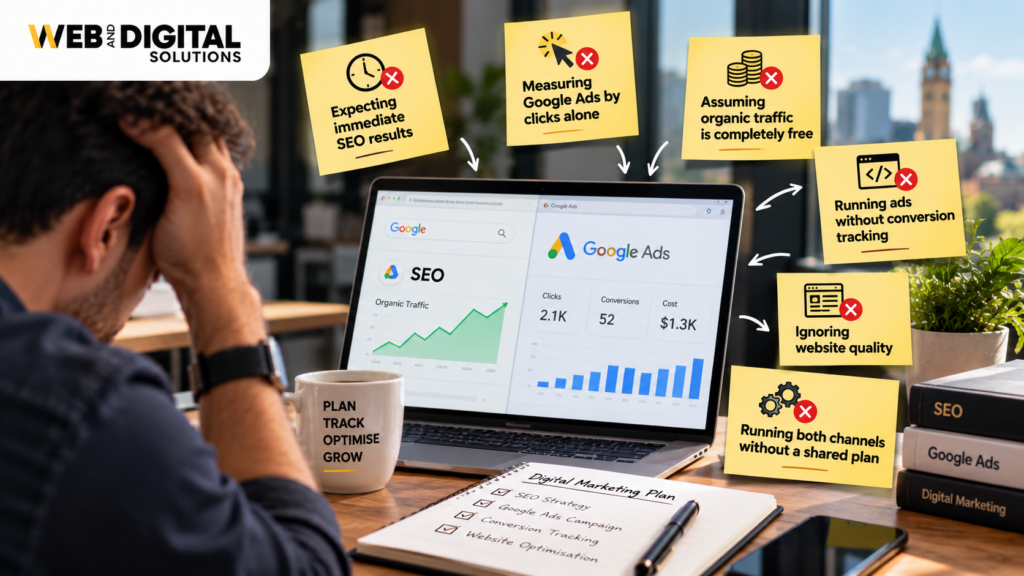
Expecting immediate SEO results
SEO involves implementation, competition and ongoing evaluation. A responsible strategy should set clear milestones without guaranteeing rankings or results by a fixed date.
Measuring Google Ads by clicks alone
Clicks demonstrate activity, but they do not establish profitability. Track qualified leads, sales and customer acquisition costs where possible.
Assuming organic traffic is completely free
Organic visits do not carry a per-click advertising charge, but SEO requires investment in strategy, content, technical work and ongoing maintenance.
Running ads without conversion tracking
Without reliable tracking, it becomes difficult to identify which campaigns generate enquiries and which waste budget.
Ignoring website quality
A relevant visitor may still leave if the website is slow, confusing or difficult to use. Improving the website experience can be important regardless of the traffic source.
Running both channels without a shared plan
SEO and Google Ads should have clear objectives and consistent measurement. Otherwise, businesses may duplicate work, send visitors to unsuitable pages or struggle to understand the combined results.
How Web & Digital Solutions Can Help
Choosing between SEO and Google Ads starts with understanding your business goals, target audience, competition and current website performance.
Web & Digital Solutions helps businesses assess organic search opportunities, improve website visibility and develop digital marketing strategies aligned with their objectives.
Explore our SEO Services in London, Ontario to learn more about building your organic search presence.
For businesses considering paid advertising alongside SEO, contact Web & Digital Solutions to discuss suitable digital marketing options and campaign requirements.
Final Thoughts
SEO vs Google Ads is not simply a choice between free traffic and paid traffic. SEO requires sustained investment to earn organic visibility, while Google Ads provides paid advertising opportunities that can be activated and adjusted according to campaign goals.
For small businesses in Ontario, the right choice depends on budget, urgency, competition, lead quality and long-term growth plans. Google Ads may help businesses pursue timely demand, while SEO can support sustained organic visibility. A combined strategy may help achieve both objectives when resources and business needs justify it.
At Web & Digital Solutions, we believe an effective digital marketing strategy should align with your business goals and measurable outcomes. Start by defining what a successful lead or sale is worth, ensuring conversion tracking works and evaluating each channel based on its contribution to your business. This gives you a stronger foundation for allocating your marketing budget and building sustainable growth over time.
Frequently Asked Question
1. Is SEO better than Google Ads for small businesses?
Neither is universally better. SEO can support long-term organic visibility, while Google Ads can provide paid visibility for relevant searches soon after a campaign launches. The right choice depends on your budget, urgency, competition and business goals.
2. Is SEO cheaper than Google Ads?
SEO does not charge a per-click advertising fee for organic visits, but it requires investment in strategy, content, technical improvements and ongoing work. Google Ads involves advertising spend and potentially additional management and landing-page costs. Compare total costs with qualified leads and customer acquisition cost.
3. How long does SEO take compared with Google Ads?
Google Ads can begin generating visibility after campaign approval and launch, but leads are not guaranteed. SEO improvements may take weeks or months to influence search visibility, with meaningful growth often requiring sustained work.
4. Can I run SEO and Google Ads at the same time?
Yes. Businesses can use Google Ads to pursue timely demand while developing organic visibility through SEO. Both channels should have clear goals, reliable conversion tracking and a coordinated strategy.
5. Which is better for local businesses in Ontario?
Local SEO can help businesses build organic visibility for relevant local searches, while Google Ads can target selected services and geographic areas. The appropriate balance depends on the business’s service area, competition, seasonal demand and lead economics.
6. Does Google Ads improve organic rankings?
Google Ads does not directly improve a website’s organic rankings simply because the business pays for advertising. Paid and organic search are separate systems, although insights from campaigns may help inform marketing decisions.
7. How should I decide my SEO and Google Ads budget?
Start with your business goals, available budget, average customer value and capacity to handle leads. Measure qualified enquiries, conversion rates and customer acquisition costs, then adjust investment based on performance rather than traffic volume alone.