What Is the Best Digital Marketing Checklist for Local Businesses?
A digital marketing checklist for local businesses in London, Ontario, should cover website performance, search visibility, Google Business Profile, customer reviews, local content and conversion tracking. These elements help customers find your business, understand your services and take the next step when they are ready to buy.
The key is to prioritize the activities that support your business goals rather than trying every marketing tactic at once.
1. Strengthen Your Local Online Presence
When people need a service, they often search Google before calling a business. They compare websites, check reviews, look at business hours and assess whether a company appears trustworthy.
Your online presence should make it easy for potential customers to find accurate information about your business.
Start by checking whether your business information is consistent across the following platforms:
- Google Search and Google Maps
- Your official website
- Relevant local and industry directories
- Social media business profiles
- Review platforms
- Other websites that mention your business
Make sure your business name, address, phone number, website URL and operating hours are accurate wherever they appear.
For businesses serving London, Ontario, local relevance also matters. Clearly communicate where you operate and which services you provide. Avoid adding locations you do not genuinely serve just to attract additional search traffic.
Action item: Search for your business name on Google. Review the information customers see before visiting your website or contacting you.
2. Optimize Your Website for SEO and Local Search
Your website should help search engines understand what your business offers and help visitors decide whether your services meet their needs.
A website can look professional and still struggle to attract qualified visitors if its service pages are unclear, important pages are difficult to find or its content does not match what customers search for.
Use this checklist to review your website.
-
Give every important page a unique, descriptive title tag.
-
Write useful meta descriptions that encourage relevant clicks.
-
Use one clear H1 heading that reflects the page’s main topic.
-
Organize supporting information with logical H2 and H3 headings.
-
Create dedicated pages for your main services where appropriate.
-
Explain your service area accurately.
-
Link related pages together using descriptive anchor text.
-
Add descriptive alt text to meaningful images.
-
Check that important pages can be crawled and indexed.
-
Submit and monitor your XML sitemap through Google Search Console.
Understand SEO, Local SEO and AI Search
These activities overlap, but each addresses a slightly different part of your online visibility.
| Area | Primary purpose | Example |
|---|---|---|
| SEO | Improve visibility in organic search results | Optimizing a service page for a relevant search query |
| Local SEO | Improve visibility for geographically relevant searches | Helping a business appear for relevant searches in London, Ontario |
| AI search optimization | Improve the clarity, usefulness and accessibility of information for AI-assisted discovery | Publishing accurate service information and well-structured answers |
Traditional SEO remains an important foundation. AI search optimization can complement it, but no particular content format or schema guarantees that an AI system will mention your business.
For a more focused approach to local visibility, explore our Local SEO services in London, Ontario.
3. Improve Your Google Business Profile
For eligible local businesses, Google Business Profile can help customers discover services through Google Search and Maps.
Your profile should accurately represent your real-world business. Adding keywords to the business name that are not part of its actual name, selecting irrelevant categories or listing locations where you have no legitimate presence can create policy risks.
Review the following items:
-
Verify that the profile is claimed and verified.
-
Use your actual business name.
-
Select the most relevant primary business category.
-
Add appropriate secondary categories where applicable.
-
Maintain accurate business hours and contact details.
-
Provide a clear, factual business description.
-
Add relevant services and service details.
-
Upload genuine, high-quality business photos.
-
Keep website and appointment links accurate.
-
Review customer questions and feedback regularly.
-
Respond professionally to genuine customer reviews.
Businesses that serve customers at their premises and service-area businesses may have different profile requirements. Set up your profile according to how the business actually operates.
Remember that profile completeness alone does not guarantee higher rankings. Relevance, distance and prominence all contribute to local search visibility.
4. Build a Genuine Customer Review Strategy
Reviews influence how potential customers evaluate a business. They can provide useful information about service quality, responsiveness and the experiences of previous customers.
However, reviews should be earned rather than manufactured.
Create a simple process for asking customers for honest feedback after a completed purchase or service.
Your review strategy should include:
- Asking customers for genuine reviews without offering incentives that violate platform policies.
- Making the review process easy to understand.
- Responding professionally to positive and negative feedback.
- Addressing legitimate customer concerns.
- Monitoring recurring feedback to identify operational improvements.
Avoid buying reviews, creating fake testimonials or asking only satisfied customers to review you in a way that selectively suppresses negative feedback.
A credible review profile supports customer confidence while giving your business useful feedback about the experience it delivers.
5. Make Your Website Fast, Mobile-Friendly and Easy to Use
Many customers discover local businesses on their phones. If your website is difficult to navigate, slow to load or unclear about the next step, potential leads may leave before contacting you.
Your website should make essential information easy to find.
Check these elements:
-
Pages display properly on mobile devices.
-
Important content is visible without excessive scrolling.
-
Navigation labels are clear.
-
Contact details are easy to locate.
-
Phone numbers are clickable on mobile.
-
Forms request only the information you genuinely need.
-
Images are appropriately sized and compressed.
-
Unnecessary scripts and plugins are minimized.
-
HTTPS works correctly.
-
Important pages have no broken links or unexpected errors.
Use Google PageSpeed Insights to review performance and Core Web Vitals. Treat the results as diagnostic information rather than assuming that a single score determines rankings.
Give Visitors a Clear Reason to Take Action
A website should not leave visitors wondering what to do next.
Depending on your business, useful calls to action may include:
- Request a Quote
- Book a Consultation
- Call Our Team
- Schedule a Service
- Get More Information
Place relevant calls to action where visitors need them, particularly on service pages and contact pages.
A clear conversion path makes it easier to turn existing traffic into enquiries without relying entirely on acquiring more visitors.
6. Create Content That Answers Local Customers’ Questions
Content marketing can attract relevant visitors, explain your expertise and support your main service pages.
The strongest content begins with real customer questions rather than a list of keywords that must be inserted into an article.
For a London, Ontario business, potential content opportunities include:
- Guides explaining how to choose a service provider.
- Answers to frequently asked questions about your services.
- Comparisons of available solutions.
- Seasonal advice relevant to your industry.
- Case studies based on genuine customer projects.
- Practical guides explaining costs, processes and common mistakes.
- Location-specific information that provides genuine value to customers.
Create dedicated service pages for your main offerings. Use supporting blog posts to answer related informational questions and link readers to the appropriate service page when it is relevant.
For example, an article about improving local visibility can link to your Local SEO service page. A supporting article about AI search can direct interested readers to your AI Search Optimization service.
This creates a useful relationship between informational content and commercial pages.
Avoid Thin or Duplicate Location Pages
Publishing a page for every nearby town does not automatically improve local rankings.
Each location page should have a genuine purpose and provide useful, location-relevant information. Explain which services are available, who they help and what customers should know before contacting you.
Avoid creating dozens of pages that repeat the same paragraphs while changing only the place name.
7. Use Social Media to Support Customer Relationships
Social media can help local businesses stay visible, communicate with customers and distribute useful content.
You do not need to publish on every platform. Choose the channels your customers actually use and maintain a realistic schedule.
A practical social media plan can include:
- Educational posts answering common customer questions.
- Genuine project photos and business updates.
- Customer testimonials shared with appropriate permission.
- Seasonal reminders relevant to your services.
- Links to useful website resources.
- Updates about service availability or business activities.
Use social media to build familiarity and direct interested users to relevant pages on your website.
Do not treat follower counts or likes as the only measure of success. Track meaningful actions such as enquiries, referral visits and interactions that support your business objectives.
8. Earn Relevant Local Citations and Links
Local citations are online mentions of your business information. They may appear in business directories, industry listings, professional associations and local organizations.
Start by identifying the listings that matter to your business and correcting inaccurate information.
Then consider opportunities to build genuine local relationships through:
- Relevant industry associations.
- Local business organizations.
- Community sponsorships.
- Professional partnerships.
- Local publications.
- Supplier and partner websites.
Prioritize relevance and credibility rather than the number of listings or links you acquire.
Avoid automated link-building packages that promise large quantities of unrelated backlinks. These may provide little value and can introduce unnecessary SEO risks.
9. Track the Metrics That Connect Marketing to Business Growth
Marketing activity is easier to evaluate when you know what it is expected to achieve.
Google Analytics 4 can help you understand website traffic and configured conversions. Google Search Console provides information about search queries, impressions, clicks and indexing.
Your reporting should connect these insights with actual business outcomes wherever possible.
| Metric | What to investigate |
|---|---|
| Organic clicks | Whether search is bringing visitors to your website |
| Search impressions | Whether your pages are appearing for relevant queries |
| Landing-page performance | Which pages attract and engage visitors |
| Google Business Profile interactions | How customers interact with your profile |
| Calls and form submissions | Whether visitors are contacting your business |
| Qualified leads | Whether enquiries match your target customers |
| Conversion rate | How effectively relevant visitors complete desired actions |
Make sure important actions, such as form submissions and phone enquiries where trackable, are configured correctly before relying on conversion reports.
Traffic growth alone does not prove that marketing is working. A smaller number of qualified visitors may be more valuable than a large amount of irrelevant traffic.
10. Follow a Practical 90-Day Digital Marketing Action Plan
If your business has several areas to improve, work in a clear sequence instead of attempting everything simultaneously.
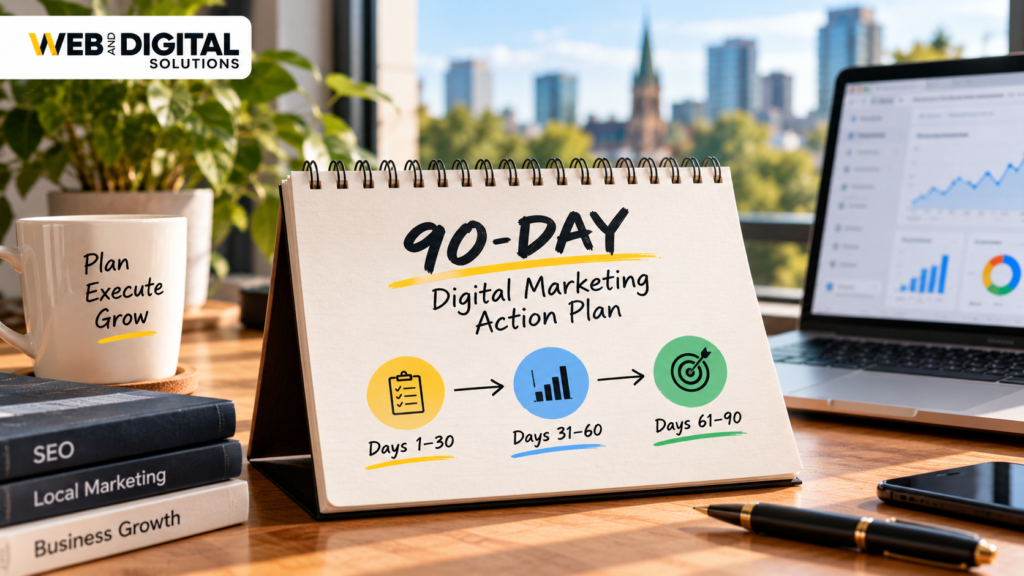
Days 1–30: Fix the Foundations
- Audit website accessibility, indexability and performance.
- Correct inaccurate business information.
- Review Google Business Profile setup.
- Improve important service pages.
- Check contact forms and conversion tracking.
- Establish baseline traffic, rankings and lead metrics.
Goal: Make sure the website and business information are accurate, accessible and ready to generate enquiries.
Days 31–60: Improve Visibility and Relevance
- Research local search queries and customer questions.
- Improve page titles, headings and internal links.
- Publish or update useful supporting content.
- Develop a legitimate review-request process.
- Correct important business citations.
- Address the technical and content issues identified during the first month.
Goal: Strengthen relevance for the services and locations that matter most to your business.
Days 61–90: Measure and Refine
- Review changes in organic clicks and search impressions.
- Evaluate Google Business Profile interactions.
- Identify pages generating relevant enquiries.
- Improve pages receiving traffic but producing few leads.
- Review the quality of enquiries and conversion tracking.
- Prioritize the next round of improvements using actual performance data.
Goal: Understand which activities are contributing to business results and where further work is needed.
These periods are a planning framework, not a guarantee of ranking improvements within 90 days.
11. Common Digital Marketing Mistakes Local Businesses Should Avoid
Even businesses investing in marketing can struggle when their activities are disconnected from customer needs.
Watch for these common problems:
Relying only on social media: Social media can support visibility, but your website and search presence remain important discovery and conversion channels.
Ignoring technical SEO: Important pages that cannot be crawled or indexed may struggle to appear in search results.
Repeating location keywords excessively: Keyword stuffing makes content less natural and does not guarantee better rankings.
Publishing content without a strategy: Every article should serve a useful audience need and fit into the broader website structure.
Buying low-quality backlinks: Unrelated or manipulative link schemes can introduce unnecessary risks.
Ignoring conversion tracking: Without reliable measurement, it is difficult to understand whether marketing is generating enquiries.
Expecting immediate results: SEO performance depends on competition, website quality, implementation and other factors. Consistent improvements and realistic evaluation are more useful than fixed ranking promises.\
Build a Consistent Digital Marketing Strategy for Your Business
A successful digital marketing strategy does not require a local business to do everything at once. It requires the right priorities, consistent execution and a clear understanding of what customers need.
Start with an accessible website, accurate business information, useful content and a well-maintained Google Business Profile. Then strengthen local visibility, improve conversion paths and measure whether your efforts are generating meaningful enquiries.
For businesses looking to improve their online presence in London, Ontario, Web & Digital Solutions helps connect SEO, local search visibility, website performance and digital strategy with practical business objectives.
The best next step is to identify the biggest gap in your current marketing, address it properly and use the results to guide your next improvement.
Frequently Asked Questions
What should be included in a digital marketing checklist for a local business?
A useful checklist covers website SEO, Google Business Profile, customer reviews, website performance, local content, citations, social media and conversion tracking. Prioritize the activities most relevant to your services, customers and business goals.
How can a small business in London, Ontario get more customers online?
Start by improving your website, optimizing your Google Business Profile, collecting genuine customer reviews and creating helpful content around your services. Track calls, enquiries and qualified leads to identify which activities contribute to business growth.
Is Local SEO more important than social media for local businesses?
The answer depends on the business and its customers. Local SEO is particularly valuable when people actively search for the services you offer, while social media can help with awareness, engagement and customer relationships. Both can work together.
How often should a local business update its website and Google Business Profile?
Update business hours, contact information and service details whenever they change. Review your website and profile regularly for accuracy, outdated content, broken links and new customer questions. Content updates should improve usefulness rather than simply make pages appear fresh.
How long does digital marketing take to produce results?
Timelines vary according to competition, existing visibility, website quality, budget and the activities involved. Technical fixes can sometimes produce relatively quick improvements, while SEO and content development may take longer. Evaluate progress using meaningful visibility, conversion and lead metrics.
Does a local business need a blog for SEO?
Not every business needs a large blog. Supporting content is useful when it answers genuine customer questions, demonstrates expertise and helps visitors find relevant services. A smaller collection of valuable articles can be more effective than publishing large quantities of repetitive content.
How can I tell whether my digital marketing strategy is working?
Review search visibility, organic traffic, landing-page performance, tracked calls, form submissions, qualified enquiries and, where possible, revenue. Compare performance against a reliable baseline and use the findings to prioritize improvements.