Search behaviour is changing. People are no longer relying only on traditional search engines to discover businesses, compare services, and find answers. They are also asking AI tools like ChatGPT questions such as:
- Which SEO company should I hire in London, Ontario?
- What are the best web design services for a small business?
- Which local company offers commercial snow removal?
- Who can help my business improve its online visibility?
For businesses, this creates a new visibility opportunity: being discovered, mentioned, or cited in AI-generated answers.
But how do you get your website to show up in ChatGPT?
The answer is not to add a special tag, publish hundreds of AI-generated articles, or repeat your business name across the internet. You need to make your website accessible, your information easy to understand, and your business credible and relevant to the questions potential customers ask.
This guide explains how ChatGPT search discovery works, what influences AI search visibility, and the practical steps businesses can take to improve their chances of appearing in ChatGPT answers.
What Does It Mean for a Website to Show Up in ChatGPT?
A website can appear in ChatGPT in different ways, and these outcomes should not be confused.
1. Your website is cited as a source
ChatGPT may provide a link to a webpage when it uses that page to support an answer generated through its search features.
2. Your business is mentioned in an answer
ChatGPT may mention your company, brand, or service when responding to a relevant question. A brand mention does not necessarily mean your website was cited.
3. Your website is discovered through ChatGPT search
When someone asks a question that requires current web information, ChatGPT Search can retrieve relevant information from the web and include source links.
These are related but different outcomes. A business can have a website that is accessible to search crawlers without being selected as a source for a particular answer.
The goal of AI SEO is to improve your business’s discoverability, relevance, and credibility across AI-powered search experiences. It does not guarantee a particular mention, recommendation, or citation.
How Does ChatGPT Find and Select Website Content?
Understanding the process helps explain why certain SEO improvements matter.
ChatGPT Search can use web search to find current information and provide answers with source links. OpenAI documents a specific crawler called OAI-SearchBot, which is used to surface websites in ChatGPT search features.
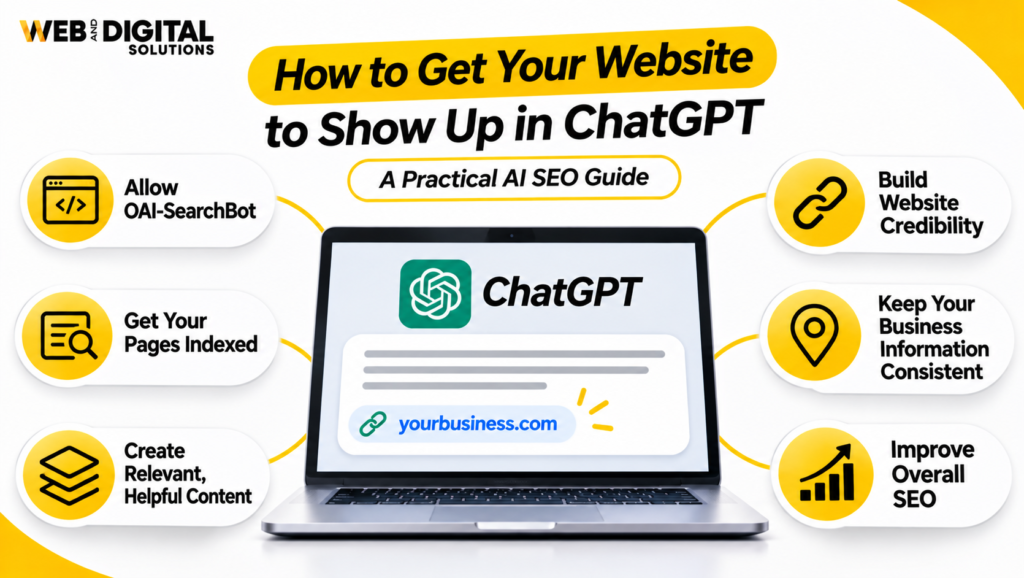
The process can be understood in four broad stages:
1. Website accessibility
The website must be accessible to the relevant crawler. If your robots.txt rules, firewall, hosting provider, or content delivery network blocks OAI-SearchBot, your pages may not be eligible to appear in ChatGPT search answers.
2. Search discovery
Relevant pages need to be discoverable. Clear website architecture, internal links, and search-engine visibility can help search systems find and understand your content.
3. Relevance and information quality
Your content needs to answer the question accurately and provide useful information. A page that directly explains a service, its location, its benefits, and its limitations may be more useful for a specific query than a page filled with broad marketing statements.
4. Source selection
ChatGPT uses multiple factors to determine which information is relevant and reliable for a query. Being crawlable does not guarantee that a page will be selected or cited.
This is why AI search visibility requires more than technical access. Your website also needs relevant, clear, and credible information.
9 Practical Ways to Get Your Website to Show Up in ChatGPT
1. Allow OAI-SearchBot to Access Your Website
This is one of the most important technical checks for ChatGPT search visibility.
OpenAI uses different crawlers for different purposes. The distinction matters:
| Crawler | Purpose |
|---|---|
| OAI-SearchBot | Helps surface websites in ChatGPT search features. |
| GPTBot | Crawls content that may be used to improve OpenAI’s foundation models. |
| ChatGPT-User | Visits webpages in response to certain user actions; it is not the automatic search crawler. |
If your goal is to make your website eligible for ChatGPT search results, review your robots.txt file and make sure OAI-SearchBot is not blocked.
A basic robots.txt example that allows OAI-SearchBot while keeping GPTBot disallowed is:
User-agent: OAI-SearchBot
Allow: /

User-agent: GPTBot
Disallow: /

User-agent: *
Allow: /
This is only an example. Your actual robots.txt file may contain additional rules for directories, assets, and other crawlers. Review the complete file before changing it.
Important: OAI-SearchBot and GPTBot serve different purposes. Blocking GPTBot does not automatically block ChatGPT search visibility. If you want to manage search access separately from model-training access, configure the relevant crawler rules independently.
Also check whether your hosting provider, firewall, or CDN blocks OpenAI’s published crawler IP addresses. A permissive robots.txt file alone may not resolve an infrastructure-level block.
You can review the official OpenAI crawler documentation for current crawler details and access guidance.
2. Make Sure Your Important Pages Are Indexed and Discoverable
Allowing OAI-SearchBot is a technical starting point, not a complete visibility strategy.
Your website’s important pages should also be accessible to search engines and organised so that relevant information can be discovered.
Review the following:
- Submit an accurate XML sitemap through Google Search Console.
- Check indexing status for important service pages.
- Fix accidental noindex directives.
- Review robots.txt restrictions.
- Use appropriate canonical tags.
- Link important pages from relevant sections of your website.
- Fix broken internal links and unnecessary redirect chains.
- Avoid leaving important service pages isolated from the rest of your site.
For example, a digital marketing agency should have clearly accessible pages for SEO, local SEO, web design, and AI search optimisation.
A single homepage that briefly lists every service may not provide enough detail for search systems or potential customers to understand the agency’s expertise.
You can also review our guide on why your website may not be showing up on Google to understand common discovery and indexing problems.
3. Create Content That Directly Answers Real Questions
AI-powered search experiences are designed to respond to questions, so your website should provide clear answers to the questions your customers actually ask.
Instead of publishing broad articles that repeat common marketing advice, build content around specific customer needs.
For example, a business offering SEO services in London, Ontario, could address questions such as:
- How much do SEO services cost in London, Ontario?
- How long does local SEO take?
- Does a small business need an SEO audit?
- How can a business improve its Google visibility?
- What is the difference between traditional SEO and AI SEO?
A useful article should:
- Address the main question early.
- Explain the answer in straightforward language.
- Include relevant details, examples, and limitations.
- Organise information with descriptive headings.
- Link to relevant service pages or supporting resources.
- Keep facts and recommendations accurate and current.
Avoid writing multiple pages that target slightly different versions of the same question but provide almost identical information.
The objective is not to produce more content. It is to publish information that genuinely helps someone make a decision.
4. Make Your Business Information Consistent Across the Web
AI systems may encounter information about your business across your website and other online sources.
If your business name, address, phone number, services, or service locations are inconsistent, it can make your online identity harder to interpret.
Review your business information across:
- Your official website.
- Google Business Profile.
- Relevant industry directories.
- Local business listings.
- Professional association profiles.
- Social media business profiles.
- Trusted partner and supplier websites.
For local businesses, make sure your website clearly communicates the areas you serve.
For example, a company targeting London, Ontario, should explain its relevant services and service area naturally throughout its website rather than inserting location keywords into every paragraph.
Consistency is important, but do not create fake listings or publish misleading business details simply to increase the number of online mentions.
5. Build Brand Authority Through Relevant Online Mentions
Your website is not the only place where people can learn about your business.
Relevant third-party references can help establish your brand’s presence and provide additional context about what your business does.
Potential sources include:
- Industry publications.
- Relevant local business directories.
- Professional associations.
- Genuine customer reviews.
- Business partnerships.
- Local news and community websites.
- Relevant interviews, case studies, and expert contributions.
Focus on earning mentions from sources that make sense for your industry.
For example, a web design company may benefit from being referenced in a relevant business publication or a local business resource. A landscaping company may benefit from genuine local partnerships and industry references.
Avoid bulk link-building schemes, fake reviews, irrelevant guest posts, and paid brand mentions that provide no real value.
Brand authority is built through a consistent, credible online presence—not by collecting as many mentions as possible.
6. Publish Detailed Service Pages That Explain What You Actually Offer
If you want ChatGPT to understand your business, make sure your website explains your services clearly.
A useful service page should answer:
- What exactly does your business offer?
- Who is the service designed for?
- Which problems does it solve?
- What is included in the service?
- Which locations do you serve?
- What makes your approach different?
- How can a potential customer contact you?
For example, an AI SEO service page should explain what AI search optimisation involves, which platforms or search experiences are considered, what work is performed, and how progress is evaluated.
Avoid vague claims such as “We make your business number one in AI search.” Such statements do not explain the service or establish a credible expectation.
A well-written service page should make sense to a human reader first. Clear information also gives search systems better context about your business.
7. Use Structured Data to Clarify Your Website Information
Structured data is a standardised way of describing information on a webpage.
For eligible content, Schema.org markup can help search engines interpret details about your organisation, services, articles, and other entities.
Depending on the page, useful schema types may include:
| Schema type | Potential use |
|---|---|
| Organization | Describes your business or organisation. |
| LocalBusiness | Describes a qualifying local business and its details. |
| Service | Describes a specific service offered. |
| Article / BlogPosting | Describes an article or blog post. |
| BreadcrumbList | Describes the page’s position in website navigation. |
For example, an SEO agency may use organisation information on its website, service markup on relevant service pages, and BlogPosting markup on articles.
However, structured data should accurately reflect visible page content. It is not a shortcut to ChatGPT citations, and adding schema does not guarantee AI search visibility.
Do not add unsupported ratings, fake reviews, or irrelevant schema properties simply to make a page appear more comprehensive.
8. Improve Content Structure So Information Is Easy to Understand
A page may contain useful information but still be difficult to interpret if it is poorly organised.
Use a structure that helps visitors find answers quickly.
Practical improvements include:
- Descriptive H1 and H2 headings.
- Short, focused paragraphs.
- Clear explanations of technical terms.
- Relevant bullet points and numbered steps.
- Tables for genuine comparisons.
- Frequently asked questions where they add value.
- Specific examples and supporting evidence.
- Clear references to the business or subject being discussed.
For instance, instead of writing:
“We provide complete digital solutions that help businesses grow online.”
Explain the actual services:
“Our SEO services include technical website audits, keyword research, on-page optimisation, content planning, internal linking, and local SEO improvements.”
The second version provides much more useful information about the work involved.
Also, make sure important information is available as readable webpage content. Do not rely exclusively on text embedded in images, videos, or inaccessible interactive elements.
9. Monitor Whether Your Website Is Appearing in AI Search Answers
AI SEO should be measured rather than treated as a one-time website update.
Create a list of questions that potential customers might ask ChatGPT about your industry, services, and location.
For example, an Ontario-based digital marketing agency could monitor questions such as:
- Which SEO agencies serve businesses in London, Ontario?
- How can a small business improve its local search visibility?
- What should I look for when hiring an SEO company?
- Which agencies offer AI search optimisation?
- How do I improve my website’s visibility in ChatGPT?
Test these questions periodically and record:
- Whether your business is mentioned.
- Whether your website is cited.
- Which specific page is referenced.
- Which competitors appear.
- Whether the answer accurately describes your services.
- Whether visibility changes across different questions.
AI-generated answers can vary based on wording, context, location, and the information available at the time. A single successful or unsuccessful test is not enough to establish a trend.
Also monitor website analytics for referral traffic from ChatGPT where available. Treat referral sessions as one measurement, not a complete picture of AI visibility.
ChatGPT SEO vs Traditional SEO: What’s the Difference?
Traditional SEO and AI SEO overlap, but they do not have exactly the same visibility objectives.
| Area | Traditional SEO | AI SEO |
|---|---|---|
| Main objective | Improve visibility in organic search results. | Improve the likelihood of being discovered, mentioned, or cited in AI-generated answers. |
| Content focus | Match search intent and provide useful pages. | Provide clear, relevant, well-supported information that can answer specific questions. |
| Technical foundation | Crawling, indexing, site structure, performance. | Accessible content, crawler permissions, clear structure, and discoverability. |
| Authority | Relevant backlinks, reputation, and trust signals. | Credible brand presence and relevant supporting information across the web. |
| Measurement | Rankings, impressions, clicks, organic traffic, conversions. | Brand mentions, source citations, AI referral traffic, and assisted conversions where measurable. |
| Platforms | Google, Bing, and other search engines. | ChatGPT and other AI-powered search or answer experiences. |
Traditional SEO remains an important foundation for AI search visibility. Businesses should not abandon search engine optimisation to chase AI citations.
A stronger approach is to create a website that serves customers well, performs technically, communicates expertise, and is accessible to relevant search systems.
Common AI SEO Myths Businesses Should Avoid
There is a lot of confusing advice about getting websites into ChatGPT. Be careful with claims that promise guaranteed visibility through one technical change.
| Myth | What businesses should understand |
|---|---|
| Adding an llms.txt file guarantees ChatGPT visibility. | No such file guarantees inclusion or citations in ChatGPT search. |
| Blocking GPTBot blocks ChatGPT Search. | GPTBot and OAI-SearchBot have different purposes. |
| Publishing hundreds of AI-written blogs improves AI visibility. | Content quantity does not replace relevance, usefulness, and quality. |
| Adding FAQ schema guarantees AI citations. | Structured data does not guarantee selection as a source. |
| A website must rank first on Google to appear in ChatGPT. | ChatGPT search uses its own retrieval and ranking processes; a specific Google position is not a guaranteed requirement. |
| More backlinks always mean more AI visibility. | Link relevance and overall credibility matter more than raw backlink counts. |
| One ChatGPT test proves whether a business is visible. | Answers can vary, so monitoring should use multiple relevant questions over time. |
The safest strategy is to focus on improvements that make your website more accessible, useful, accurate, and trustworthy.
A Practical AI SEO Checklist for Your Website
Use this checklist to review your website’s readiness for ChatGPT search discovery.
Technical accessibility
-
OAI-SearchBot is not blocked by robots.txt.
-
Hosting, firewall, and CDN settings do not unintentionally block relevant crawler requests.
-
Important website pages return successful responses.
-
Important pages are not accidentally marked noindex.
-
XML sitemap is accurate and submitted to Google Search Console.
-
Internal links make important pages discoverable.
Content quality
-
Main service pages explain exactly what the business offers.
-
Content answers relevant customer questions.
-
Articles use clear headings and logical structure.
-
Claims are accurate and supported where necessary.
-
Content is regularly reviewed for outdated information.
-
Important information is available in readable webpage text.
Brand credibility
-
Business name, address, and contact details are consistent.
-
Google Business Profile information is accurate where applicable.
-
Relevant industry and local business profiles are maintained.
-
Customer reviews are genuine.
-
Brand mentions and backlinks come from relevant sources.
AI visibility monitoring
-
A list of relevant customer questions has been created.
-
ChatGPT answers are tested periodically.
-
Brand mentions and website citations are recorded separately.
-
Competitor visibility is reviewed.
-
AI referral traffic is monitored where analytics can identify it.
-
Results are evaluated over time rather than from one test.
How Long Does It Take to Appear in ChatGPT?
There is no fixed timeline for appearing in ChatGPT answers.
A website may become eligible for ChatGPT search discovery after relevant crawler access is available, but being eligible does not guarantee that it will be selected for a particular query.
The timeline depends on factors such as:
- Whether the website is accessible to OAI-SearchBot.
- How quickly relevant pages are discovered.
- The relevance and quality of the content.
- Competition for the questions being monitored.
- The credibility and clarity of the business information.
- Changes in search systems and the information available for a query.
OpenAI’s crawler documentation notes that its systems may take approximately 24 hours to adjust after a robots.txt update. That refers to crawler access changes—not a guarantee that your website will appear in ChatGPT within 24 hours.
A sensible approach is to fix technical access first, improve the most important pages, build relevant supporting content, and monitor visibility consistently.
How Web & Digital Solutions Can Help Improve Your AI Search Visibility
Getting your website discovered in AI-powered search experiences requires a combination of technical SEO, content optimisation, brand positioning, and ongoing analysis.
At Web & Digital Solutions, we help businesses strengthen their online presence through SEO and AI search optimisation.
Our approach can include:
- Reviewing website accessibility and crawlability.
- Checking OAI-SearchBot access and technical restrictions.
- Improving service-page content and website structure.
- Developing question-focused content around customer search behaviour.
- Strengthening internal linking and relevant topical coverage.
- Reviewing brand information and online references.
- Implementing appropriate structured data.
- Monitoring AI search mentions, citations, and referral activity where measurable.
If you want to understand how your website can become more discoverable across traditional and AI-powered search experiences, explore our AI Search Optimization Services in London, Ontario.
You can also review our SEO Services to understand how traditional SEO supports a stronger foundation for online visibility.
Final Thoughts
Getting your website to show up in ChatGPT is not about finding a secret ranking trick. It is about making your website accessible, providing useful and accurate information, establishing a credible online presence, and ensuring your business is easy to understand.
Start with the technical basics. Check OAI-SearchBot access, review your important pages, and make sure your content answers the questions your customers are asking.
Then build on that foundation with useful service pages, relevant articles, consistent business information, and credible brand references.
The objective is bigger than getting one ChatGPT citation. It is to make your business easier to discover and trust wherever potential customers search for answers.
If your business wants to improve its visibility in AI-powered search, contact Web & Digital Solutions to discuss an AI SEO strategy.
Frequently Asked Questions About ChatGPT SEO
1. How do I get my website to show up in ChatGPT?
Make sure your website is publicly accessible, allow OAI-SearchBot to crawl relevant pages, publish useful and accurate content, and build a credible online presence. These steps can improve eligibility and discoverability, but they do not guarantee that ChatGPT will cite your website.
2. What is OAI-SearchBot?
OAI-SearchBot is an OpenAI web crawler used to surface websites in ChatGPT search features. Website owners can manage its access through robots.txt and should also check whether their hosting or CDN blocks its requests.
3. Is ChatGPT SEO different from traditional SEO?
ChatGPT SEO focuses on improving a business’s discoverability, mentions, and citations in AI-powered answers. Traditional SEO focuses on visibility in organic search results. Both benefit from accessible websites, relevant content, clear information, and credibility.
4. Does my website need to rank on Google to appear in ChatGPT?
A specific Google ranking position is not a guaranteed requirement for appearing in ChatGPT. However, a technically accessible website with useful content and strong search discoverability has a better foundation for being found through web search experiences.
5. Does adding llms.txt help my website appear in ChatGPT?
An llms.txt file does not guarantee ChatGPT visibility or citations. Businesses should prioritise crawler accessibility, useful website content, clear information architecture, and credible online references rather than treating this file as a ranking shortcut.
6. How can I check if ChatGPT mentions my business?
Test relevant customer questions in ChatGPT periodically. Record whether your business is mentioned, whether your website is cited, and which pages appear as sources. Also review analytics for identifiable ChatGPT referral traffic where available.
7. How long does AI SEO take to show results?
There is no universal timeline. Technical access changes may be reflected relatively quickly, but content discovery, source selection, brand recognition, and consistent visibility depend on several factors. Monitor results over time rather than expecting guaranteed citations within a fixed period.