Search engines have traditionally helped people find websites by displaying a list of relevant pages. But the way people search for information is evolving.
Today, users can ask AI-powered platforms questions such as:
- Which digital marketing agency can help my small business?
- What is the difference between SEO and GEO?
- Which website platform is suitable for a growing business?
- How can I improve my company’s visibility in AI search results?
Instead of only presenting a list of links, generative AI tools can produce conversational answers, summarise information, compare options, and sometimes cite the websites they use.
This shift has created a growing area of digital marketing called Generative Engine Optimization (GEO).
But what is GEO, how does it work, and does your business need it?
In this guide, we explain the meaning of generative engine optimisation, how it relates to traditional SEO, what influences AI search visibility, and how businesses can approach GEO in a practical way.
What Is Generative Engine Optimization (GEO)?
Generative Engine Optimization (GEO) is the practice of improving a website’s content, information, and online presence so that it has a better opportunity to be discovered, understood, mentioned, or cited by generative AI-powered search and answer platforms.
These platforms can include experiences such as:
- ChatGPT Search
- Google AI Overviews and AI Mode
- Microsoft Copilot
- Perplexity
- Other AI-powered search and answer tools
Traditional search engines generally present users with a selection of webpages. Generative engines can retrieve information from different sources and use it to construct a response in natural language.
GEO focuses on making your business and its information relevant and accessible within these experiences.
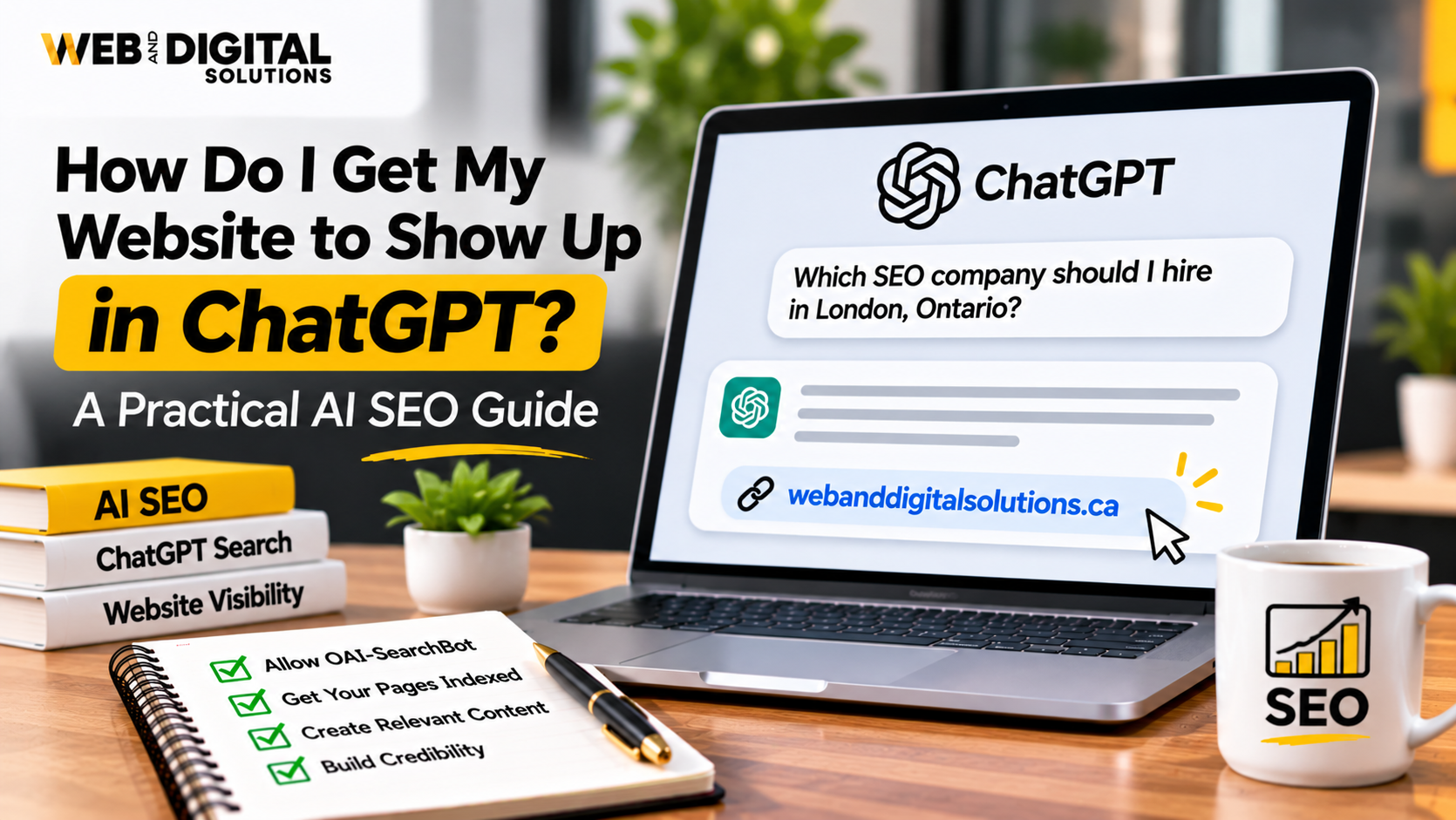
For example, imagine someone asks an AI search tool:
“Which companies provide SEO services in London, Ontario?”
A generative search experience may produce an answer that discusses relevant providers and includes links to supporting websites.
A business with clear service information, relevant content, and a credible online presence may have a better opportunity to be considered as a source.
However, GEO does not guarantee that an AI platform will mention or recommend a particular business. The answer depends on the platform, query, available sources, and retrieval and selection processes.
How Does Generative Engine Optimization Work?
To understand GEO, it helps to understand how generative search experiences gather and use information.
Although individual platforms work differently, the process can be explained through four broad stages.
1. Information Discovery
AI-powered search experiences need to discover relevant information from available sources.
Depending on the platform and query, information may come from:
- Publicly accessible websites.
- Search indexes and retrieval systems.
- Relevant business and organisation information.
- Published articles and research.
- Other available information sources.
This is why website accessibility matters. If important pages cannot be crawled or discovered, they may be less likely to be considered by systems that rely on those pages.
2. Content Retrieval
When someone asks a question, a generative search system may retrieve information relevant to the query.
For example, a user searching for “how much does local SEO cost?” may need information about pricing factors, services, business size, and competition.
Pages that address the question clearly and provide relevant detail may be useful during retrieval.
GEO therefore involves understanding the questions your audience asks and creating content that addresses those needs.
3. Information Processing and Answer Generation
The platform processes retrieved information and generates a response based on its systems and available context.
It may summarise information, compare different sources, or combine relevant details into a conversational answer.
This does not mean that every retrieved page will appear in the final response. The platform determines which information is relevant to the user’s question.
4. Mentions and Source Citations
Some AI search experiences provide citations or source links alongside their answers.
A business may receive visibility in different ways:
- Its website is cited as a source.
- Its brand is mentioned in the response.
- Its content supports an answer without a visible citation.
- Its information is not selected for that particular response.
These outcomes should be tracked separately. A brand mention is not necessarily the same as a website citation, and neither guarantees website visits or leads.
GEO vs SEO vs AEO: What Is the Difference?
You may have encountered three related terms: SEO, GEO, and AEO.
They overlap, but they describe different optimisation objectives.
| Area | SEO | GEO | AEO |
|---|---|---|---|
| Full form | Search Engine Optimization | Generative Engine Optimization | Answer Engine Optimization |
| Main focus | Improving visibility in organic search results. | Improving visibility in generative AI responses and citations. | Improving the chances of being selected for direct answers. |
| Typical experience | Search results with website listings. | AI-generated responses that may combine information from multiple sources. | Direct answers, featured snippets, voice answers, and answer-focused search experiences. |
| Content approach | Relevant pages that satisfy search intent. | Clear, useful, credible information that AI systems can retrieve and interpret. | Concise, structured answers to specific questions. |
| Measurement | Rankings, impressions, clicks, organic traffic, conversions. | AI mentions, citations, referral visits, and assisted conversions where measurable. | Answer visibility, featured snippets, answer appearances, and related traffic. |
The boundaries are not absolute. GEO and AEO are evolving terms, and different marketers may use them in slightly different ways.
Traditional SEO remains an important foundation. Technical accessibility, useful content, relevant authority, and clear website structure can support all three approaches.
Why Is Generative Engine Optimization Important for Businesses?
People increasingly use conversational tools to research products, compare services, and understand complex topics.
This creates another opportunity for businesses to become visible during the customer’s research process.
Here are five reasons GEO deserves attention.
1. Search Behaviour Is Expanding Beyond Traditional Results
Potential customers may use Google for one search, ChatGPT for another question, and a platform such as Perplexity to explore a topic further.
Businesses that focus only on traditional rankings may overlook these additional discovery experiences.
GEO helps expand your visibility strategy beyond conventional search listings.
2. AI Answers Can Influence Customer Research
Generative search tools can summarise information and help users compare different options.
A customer researching SEO services, for example, may ask an AI platform to explain what an SEO agency does, what services are included, or which factors to consider before hiring one.
If your website provides useful information on these topics, it may have an opportunity to contribute to that research.
3. Brand Visibility Can Extend Beyond Website Clicks
Not every customer journey begins with a website visit.
A potential customer may first encounter your business name in an AI-generated answer and visit your website later through another channel.
This makes it important to consider brand mentions and citations alongside conventional traffic metrics.
4. Useful Content Can Support Multiple Search Experiences
Content created to answer genuine customer questions can support traditional search, answer engines, and generative AI experiences.
For example, a detailed article explaining the cost factors involved in website development can serve visitors arriving through different search platforms.
The value comes from the usefulness of the information, not simply from writing content for an AI system.
5. Businesses Can Build a More Complete Search Strategy
GEO should not replace SEO. It should complement it.
A website that is technically accessible, well organised, informative, and credible has a stronger foundation for being discovered across different search experiences.
8 Practical GEO Strategies to Improve AI Search Visibility
GEO is not about finding a secret formula to influence AI-generated answers. It involves improving the quality, accessibility, and clarity of the information associated with your business.
Here are eight practical areas to work on.
1. Make Your Website Accessible to Relevant Crawlers
Technical accessibility is an important starting point.
If your website blocks a crawler used by an AI search platform, the affected system may not be able to access your pages through that crawler.
For ChatGPT Search, website owners should review the access rules for OAI-SearchBot.
Check:
- Your robots.txt file.
- Whether important pages return successful HTTP responses.
- Whether your hosting provider blocks crawler requests.
- Firewall and CDN restrictions.
- Accidental noindex directives.
- Whether important content is accessible without a login.
Remember that different crawlers have different purposes. For example, OpenAI documents OAI-SearchBot for ChatGPT search discovery and GPTBot for potential model-training use.
Allowing one does not automatically require allowing the other.
For platform-specific requirements, review the relevant official crawler documentation.
2. Create Content Around Real Customer Questions
Generative search is often conversational. Users ask complete questions rather than entering only short keywords.
Your content strategy should reflect this behaviour.
For example, a business offering web design services could create useful content addressing:
- How much does a small business website cost?
- What should a business website include?
- How long does website development take?
- Should I choose WordPress or Shopify?
- What makes a website mobile-friendly?
Each article should answer a specific question with accurate, useful information.
A practical structure is:
- Introduce the question.
- Provide a direct explanation.
- Break down the important factors.
- Include relevant examples.
- Explain limitations or exceptions.
- Link to a related service or resource.
Avoid publishing multiple articles that repeat the same information with slightly different keywords.
3. Build Detailed and Clear Service Pages
Your service pages should explain your business in enough detail for both visitors and search systems to understand what you offer.
A strong service page should include:
- Service name and description.
- Problems the service addresses.
- Who the service is suitable for.
- Deliverables or work involved.
- Relevant locations or service areas.
- Examples, evidence, or case studies where available.
- Frequently asked questions where useful.
- A clear contact or enquiry option.
For example, a page about AI search optimisation should explain what GEO and AI SEO involve, which activities are included, and how performance can be assessed.
Avoid relying on broad statements such as “We help businesses dominate AI search.” Explain the actual work instead.
4. Strengthen Your Brand’s Online Presence
AI systems may encounter information about your business across multiple online sources.
A consistent and credible brand presence can help clarify your business identity, services, and areas of expertise.
Review your presence across:
- Your official website.
- Google Business Profile, where applicable.
- Relevant business directories.
- Industry publications.
- Professional associations.
- Social media business profiles.
- Genuine customer reviews.
- Relevant partnerships and business references.
Make sure your business name, contact details, service descriptions, and location information are accurate.
Focus on relevant references rather than generating large numbers of low-quality listings or artificial brand mentions.
5. Publish Original, Useful, and Well-Supported Information
Generic content that repeats widely available information gives readers little reason to choose your website as a resource.
Try to add value through:
- Original research or observations.
- Practical examples from your industry.
- Clear explanations of complex topics.
- First-hand experience where appropriate.
- Relevant case studies with verifiable results.
- Expert commentary.
- Accurate references and supporting sources.
For example, an SEO agency could publish an article explaining how it approaches a technical SEO audit, including the issues it checks and how it prioritises fixes.
Do not invent case studies, statistics, customer results, or expertise. Credibility depends on the accuracy of what you publish.
6. Organise Information with Clear Headings and Structure
A useful webpage should be easy to navigate and understand.
Use:
- One clear primary heading.
- Descriptive section headings.
- Short, focused paragraphs.
- Bullet points for related information.
- Tables for genuine comparisons.
- Definitions for technical terminology.
- FAQs that address additional customer questions.
For example, an article about local SEO can use sections covering Google Business Profile, local landing pages, reviews, local citations, and performance measurement.
This makes the information easier for visitors to scan and understand. It also provides clearer context about the topics covered on the page.
7. Use Structured Data Where Appropriate
Structured data helps describe webpage information in a standardised format.
Depending on the content, relevant Schema.org types may include:
| Schema type | Purpose |
|---|---|
| Organization | Describes a business or organisation. |
| LocalBusiness | Describes a qualifying local business. |
| Service | Describes a service offered by a business. |
| Article / BlogPosting | Describes an article or blog post. |
| BreadcrumbList | Describes website navigation hierarchy. |
For example, a digital marketing agency can use appropriate organisation markup and describe its services on relevant service pages.
Structured data should match the visible content and accurately describe the page.
It does not guarantee AI citations, special placements, or recommendations. Avoid adding irrelevant or misleading schema simply to increase markup coverage.
8. Monitor Brand Mentions and AI Citations
GEO requires ongoing observation.
Create a list of questions your potential customers might ask AI platforms and test them regularly.
For a business targeting London, Ontario, examples could include:
- Which SEO agencies serve businesses in London, Ontario?
- What should I look for when hiring a digital marketing agency?
- Which companies offer AI search optimisation?
- How can a small business improve its visibility in AI search?
- What does a professional SEO audit include?
Record the following:
| Metric | What to monitor |
|---|---|
| Brand mentions | Whether your business name appears in an answer. |
| Website citations | Whether your website is linked as a source. |
| Cited pages | Which URLs are referenced. |
| Competitor mentions | Which competing businesses appear. |
| Referral traffic | Visits attributed to AI platforms where analytics can identify them. |
| Leads and conversions | Whether measurable enquiries or sales follow AI-referred visits. |
Test more than one question and repeat the process over time. AI responses can vary with query wording, context, location, and available information.
How Can You Measure GEO Performance?
One challenge with GEO is that there is no single universal metric that captures every form of AI visibility.
Traditional SEO reporting often focuses on keyword rankings, impressions, clicks, and conversions. GEO requires additional observation.
Consider using a combination of the following measures.
AI brand mention frequency
Track how often your business appears in a defined set of relevant AI queries.
Keep the questions consistent when comparing results over time.
Website citation frequency
Record how often your website is linked as a source in AI-generated answers.
Separate website citations from general brand mentions.
Source page visibility
Identify which pages are cited most frequently. This can reveal which content topics and service pages are receiving attention.
AI referral sessions
Review analytics for identifiable referrals from platforms such as ChatGPT and Perplexity, where available.
Referral traffic may not capture every AI-influenced visit, so it should not be treated as a complete measure of GEO performance.
Qualified enquiries and conversions
Ultimately, business outcomes matter.
Track whether AI-referred visitors submit forms, call your business, request quotes, or complete purchases. Compare lead quality where enough data is available.
Important: A rise in AI mentions does not automatically mean an increase in qualified leads. Measure visibility and business performance separately.
Common GEO Mistakes Businesses Should Avoid
As interest in generative engine optimisation grows, so does the amount of misleading advice.
Avoid these common mistakes:
| Mistake | Better approach |
|---|---|
| Publishing hundreds of low-value AI-generated articles. | Publish useful content that answers real customer questions. |
| Assuming an llms.txt file guarantees AI visibility. | Prioritise accessibility, relevant content, and credible information. |
| Blocking every AI crawler without understanding the consequences. | Review each crawler’s purpose and make an informed access decision. |
| Adding schema to every page without checking relevance. | Use accurate structured data that matches visible content. |
| Buying irrelevant backlinks or brand mentions. | Build genuine industry and business references. |
| Treating one ChatGPT response as proof of success. | Monitor a consistent set of relevant questions over time. |
| Ignoring traditional SEO. | Maintain strong technical SEO, content, and website foundations. |
| Measuring only AI mentions. | Connect visibility monitoring with referral traffic and qualified conversions. |
The strongest GEO strategy is built around sustainable website quality and useful information rather than shortcuts.
Does GEO Replace Traditional SEO?
No. GEO should be considered an extension of a broader search visibility strategy, not a replacement for traditional SEO.
Traditional SEO helps search engines crawl, understand, index, and rank relevant webpages. GEO focuses on improving the chances that your business information will be discovered, retrieved, understood, mentioned, or cited in generative AI experiences.
There is considerable overlap between the two.
For example, improving a service page can benefit both approaches when the improvement makes the page more useful, accessible, and relevant.
A practical combined strategy includes:
- Technical SEO to improve accessibility and crawlability.
- Keyword and search-intent research to understand customer needs.
- High-quality service pages and supporting content.
- Relevant internal links and website structure.
- Credible brand references and reputation.
- Appropriate structured data.
- Ongoing search and AI visibility monitoring.
Businesses should continue investing in SEO fundamentals while adapting their content and measurement practices to new search experiences.
How Web & Digital Solutions Approaches GEO and AI Search Optimization
At Web & Digital Solutions, we recognise that online discovery is expanding beyond traditional search engine results.
Businesses need a website that communicates their services clearly, provides useful information, and supports visibility across evolving search experiences.
Our AI search optimisation approach can include:
- Website accessibility and technical SEO reviews.
- AI crawler access checks.
- Search-intent and question-based content research.
- Service-page and content optimisation.
- Website structure and internal linking improvements.
- Brand information and online presence reviews.
- Appropriate structured data implementation.
- AI mention and citation monitoring.
- Performance analysis and ongoing optimisation.
Our focus is on practical improvements that support both traditional organic visibility and emerging AI-powered search experiences.
Explore our AI Search Optimization Services in London, Ontario to learn more.
You can also explore our SEO Services to understand how technical SEO, content optimisation, and website improvements support a stronger search foundation.
Final Thoughts: GEO Is About Making Your Business Easier to Discover
Generative Engine Optimization is an evolving area of digital marketing that focuses on improving how businesses and their information appear across AI-powered search and answer experiences.
It is not a replacement for SEO, and it does not offer a guaranteed way to appear in ChatGPT, Google AI Overviews, or other generative search platforms.
The practical approach is to build a website that is accessible, informative, well organised, and supported by a credible online presence.
Start by reviewing your technical foundations, improving your service pages, answering customer questions, and monitoring AI mentions and citations over time.
The goal is not simply to appear in an AI-generated answer. It is to make your business a relevant, credible source when potential customers are researching the services you provide.
If you want to explore how GEO can fit into your digital marketing strategy, contact Web & Digital Solutions to discuss your website and AI search visibility goals.
Frequently Asked Questions About Generative Engine Optimization
1. What is generative engine optimization (GEO)?
Generative Engine Optimization (GEO) is the practice of improving website content, information, and online presence to increase the opportunity for a business to be discovered, mentioned, or cited in AI-generated answers. It focuses on visibility across generative AI-powered search and answer experiences.
2. How does generative engine optimization work?
GEO involves making information accessible to relevant systems, creating useful content that addresses user questions, strengthening brand credibility, and improving website structure. AI platforms may retrieve information from available sources and use selected information when generating answers.
3. What is the difference between GEO and SEO?
SEO focuses on improving visibility in traditional organic search results, while GEO focuses on visibility in generative AI answers and citations. The two approaches overlap because both benefit from technically accessible websites, relevant content, clear information, and credibility.
4. Is GEO the same as AI SEO?
The terms AI SEO and GEO are closely related, but their usage can vary. AI SEO is often used as a broader term for optimising visibility across AI-powered search experiences, while GEO specifically refers to improving visibility in generative engine responses.
5. Does GEO help a website appear in ChatGPT?
GEO can help improve the technical accessibility, relevance, and clarity of website information, which may support discoverability in ChatGPT search. However, no GEO technique can guarantee that ChatGPT will mention or cite a particular website.
6. Is GEO important for small businesses?
GEO may be relevant to small businesses that want to improve their visibility when potential customers use AI tools to research services, compare providers, or ask industry-related questions. The value depends on customer search behaviour, competition, and the business’s ability to measure meaningful outcomes.
7. How long does it take to see results from GEO?
There is no standard GEO timeline. Results depend on website accessibility, content quality, brand presence, platform behaviour, and competition. Businesses should make improvements consistently and monitor mentions, citations, referral traffic, and qualified enquiries over time.