Want to Rank Higher on Google? 12 SEO Improvements That Can Make a Real Difference
Your website is live. Your services are listed. You publish blogs, update pages, and perhaps even invest in SEO. Yet when potential customers search for the services you offer, your competitors keep appearing ahead of you.
Sound familiar?
Improving your Google rankings is not about adding more keywords to every page or publishing articles simply to keep your website active. It requires a structured approach to understanding what people search for, creating pages that satisfy their needs, improving your website’s technical foundations, and building credibility over time.
So, how can you improve your Google search ranking without wasting time on SEO activities that deliver little value?
The answer is to prioritise the improvements that address your website’s actual weaknesses.
In this guide, we cover 12 practical SEO improvements that can help businesses strengthen their organic search visibility. From search intent and content optimisation to technical SEO, internal linking, backlinks, and performance monitoring, each recommendation focuses on work that supports a stronger search strategy.
First, Understand What Influences Google Search Rankings
Google does not use one single ranking factor to decide which website appears first. Its automated ranking systems evaluate many signals to identify pages that are relevant and useful for a particular search.
These systems consider factors and signals related to relevance, content, usability, links, and other aspects of the search experience.
This means there is no guaranteed shortcut to the top of Google.
A website can have excellent technical performance but still struggle to rank if its content does not satisfy search intent. Similarly, a detailed article may offer useful information but remain difficult to discover if the website has serious crawling or indexing problems.
The best approach is to understand which areas are limiting your website and improve them in the right order.
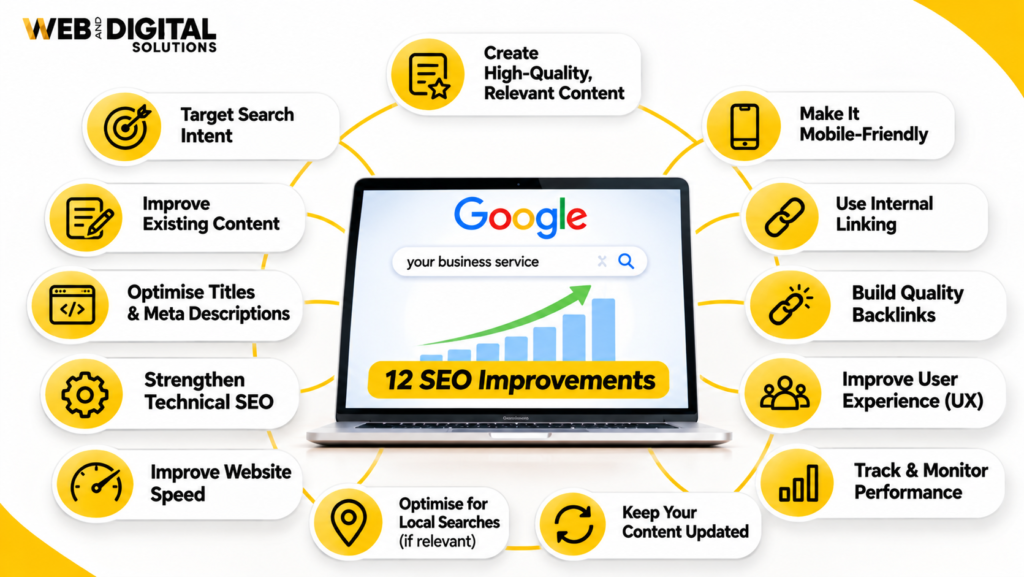
12 SEO Improvements That Can Help Your Website Rank Higher on Google
1. Target the Search Intent Behind Every Keyword
One of the biggest SEO mistakes is choosing keywords based only on search volume.
A keyword may attract thousands of searches, but if your page does not match what people want to find, it may struggle to compete.
Search intent refers to the purpose behind a search query. Users generally search to learn something, compare solutions, find a particular website, or take an action.
For example:
| Search query | Likely intent | Suitable page |
|---|---|---|
| What is technical SEO? | Informational | Educational blog |
| Best SEO agency in Ontario | Commercial investigation | Comparison or service content |
| SEO services London Ontario | Transactional / local commercial | SEO service page |
| How to improve Google rankings | Informational | Detailed SEO guide |
Before targeting a keyword, search for it on Google and review the pages already appearing in the results.
Ask yourself:
- Are the results mostly blogs or service pages?
- Are searchers looking for instructions, comparisons, or providers?
- Does your proposed page provide the type of information they expect?
- Can your content answer the query more clearly and usefully?
Create content that matches the searcher’s purpose rather than forcing every keyword onto a commercial landing page.
2. Improve Existing Content Before Publishing More Blogs
Publishing new content is not always the fastest or most useful way to improve organic visibility.
Your website may already have pages receiving impressions, ranking on the second or third page, or attracting visitors without generating meaningful engagement.
These pages may offer opportunities for improvement.
Start by reviewing Google Search Console and identifying:
- Pages receiving impressions but relatively few clicks.
- Relevant queries where your pages have visibility but weak positions.
- Pages with declining organic clicks.
- Articles that contain outdated or incomplete information.
- Service pages that do not fully explain their offerings.
Then improve the content based on what the data reveals.
For example, if a blog targets a keyword about website redesign but does not cover redirects, URL mapping, or tracking, expanding those relevant sections may make the page more useful.
Do not rewrite a page simply to make it longer. Improve its accuracy, completeness, structure, and usefulness.
3. Optimise Page Titles and Meta Descriptions
Your page title helps communicate the subject of a page to search engines and users. It can also influence how your page is presented in search results.
A vague or duplicated title may fail to communicate why a page is relevant to a particular search.
For example:
Weak title: Services | Home
More descriptive title: SEO Services in London Ontario | Web & Digital Solutions
A good title should:
- Clearly describe the page.
- Reflect its primary search topic.
- Include the target keyword naturally where appropriate.
- Distinguish the page from other pages on your website.
- Avoid unnecessary keyword repetition.
Meta descriptions provide a short summary of the page. Google may use them to generate search snippets, although it can also select different text from the page.
Write descriptions that explain what the visitor can expect and why the page may be useful.
Do not treat meta descriptions as a direct ranking factor. Their main purpose is to communicate page relevance and encourage suitable searchers to visit.
4. Build Useful, Well-Structured Content
A page should answer the questions people have about its subject without making them work unnecessarily hard to find the information.
For a business service page, this may mean explaining:
- What the service includes.
- Who needs it.
- What problems it addresses.
- How the process works.
- Which locations are served.
- What makes the business relevant to the customer’s needs.
- How visitors can request more information.
For an educational blog, it may mean providing step-by-step guidance, examples, comparisons, and answers to common questions.
Use clear headings, concise paragraphs, useful lists, and relevant examples to make the information easier to navigate.
Avoid writing for a word-count target alone. A longer article is not automatically better than a shorter one. The content should be as detailed as necessary to satisfy the intended search.
5. Fix Technical SEO Issues That Affect Crawling and Indexing
Before expecting your pages to rank, make sure search engines can discover and access them.
Technical SEO provides the foundation for your website’s search visibility.
Review important areas such as:
- Robots.txt restrictions.
- Noindex directives.
- XML sitemap accuracy.
- Canonical tags.
- Broken internal links.
- Redirect chains and loops.
- Incorrect HTTP status codes.
- Duplicate URLs.
- Mobile accessibility.
Use Google Search Console to inspect indexing reports and individual URLs. A crawler such as Screaming Frog can help identify technical issues across the website.
Prioritise problems that affect important pages rather than treating every automated warning as equally serious.
For example, an unintended noindex directive on your main service page is more urgent than a minor technical recommendation affecting an unimportant page.
6. Improve Website Speed and Core Web Vitals
Website performance matters because visitors expect pages to load and respond without unnecessary delays.
A slow or unstable experience can make it harder for users to navigate your website, read information, or complete enquiries.
Google uses Core Web Vitals as part of its page experience considerations.
The current good-performance thresholds are:
- Largest Contentful Paint (LCP): 2.5 seconds or less.
- Interaction to Next Paint (INP): 200 milliseconds or less.
- Cumulative Layout Shift (CLS): 0.1 or less.
These thresholds are assessed at the 75th percentile.
Use Google PageSpeed Insights to investigate representative pages. Review field data where available and distinguish it from laboratory test results.
Common improvement opportunities include:
- Compressing oversized images.
- Using modern image formats where appropriate.
- Reducing unnecessary JavaScript.
- Reviewing third-party scripts.
- Improving server response times.
- Optimising font loading.
- Reserving space for images and other visual elements to reduce layout shifts.
Do not focus on achieving a perfect test score at the expense of useful website functionality. Prioritise improvements that make a meaningful difference to real visitors.
7. Strengthen Internal Linking Across Your Website
Internal links connect pages within your own website. They help visitors discover related information and help search engines understand your website’s structure.
A website with isolated service pages and disconnected blog posts may not communicate its content relationships effectively.
Build a logical linking structure around your main topics.
For example:
- Your homepage links to your primary service pages.
- Your SEO service page links to relevant supporting resources.
- Your technical SEO articles link to related technical services.
- Your blog posts connect to relevant service pages where readers may need further help.
Use descriptive anchor text that explains what the linked page is about.
For example, an article about local search visibility can link naturally to your local SEO services in London, Ontario.
Avoid adding links simply to increase the number of internal links. Every link should help visitors or provide useful context.
8. Earn Relevant, High-Quality Backlinks
Backlinks are links from other websites pointing to your website. They can help search engines discover content and understand relationships between websites.
However, not all backlinks provide the same value.
A large number of irrelevant, low-quality links does not automatically make a website more authoritative.
Focus on earning relevant links through activities such as:
- Publishing genuinely useful resources.
- Creating original research or industry insights.
- Contributing expert commentary to relevant publications.
- Building legitimate business and industry relationships.
- Participating in relevant local organisations and associations.
- Earning citations from reputable sources.
For local Ontario businesses, relevant local mentions and industry references can also support visibility and brand recognition.
Avoid buying links in schemes designed to manipulate rankings, participating in link exchanges at scale, or using automated backlink packages. These practices can introduce search policy risks.
The objective should be to build a credible online presence, not simply increase a backlink count.
9. Optimise Your Website for Local Search
If your business serves customers in a particular Ontario city or region, local SEO should be part of your ranking strategy.
Potential customers may search using a service combined with a location, such as:
- SEO services London Ontario.
- Web design company in London Ontario.
- Commercial landscaping London Ontario.
- Digital marketing agency Ontario.
Review your Google Business Profile and website to ensure they accurately communicate your services and locations.
Focus on:
- Accurate business details.
- Relevant business categories.
- Genuine customer reviews.
- Consistent contact information.
- Useful location and service-area content.
- Relevant local business references.
- Clear service descriptions on your website.
If you serve multiple communities, create location pages only when they offer useful information specific to those locations.
Do not create dozens of near-identical pages just to target different city names. Local relevance and genuine service availability matter.
10. Improve Mobile Usability and the Overall Website Experience
A website should work well for visitors regardless of the device they use.
If your mobile navigation is confusing, forms are difficult to complete, or important information is hidden, potential customers may leave before contacting your business.
Review your website on different screen sizes.
Check:
- Whether text is easy to read.
- Whether menus are easy to navigate.
- Whether buttons are accessible.
- Whether contact forms work properly.
- Whether images display correctly.
- Whether visitors can find important service information.
- Whether calls to action are clear.
Also check that mobile visitors can access the same essential content as desktop users.
A good website experience supports both visitors and your wider digital marketing objectives.
11. Demonstrate Experience, Expertise, and Trust
When visitors arrive on your website, they need reasons to trust the information and the business behind it.
Your website should clearly communicate who you are, what you do, and why your business is relevant to the services you provide.
Useful trust-building elements may include:
- Detailed service information.
- Genuine customer testimonials.
- Relevant case studies.
- Clear business contact details.
- Information about your team and experience.
- Accurate credentials and qualifications.
- Transparent explanations of your process.
For informational content, provide useful explanations and make sure important claims are accurate and supported where necessary.
Avoid exaggerated promises, fabricated testimonials, and unsupported performance claims.
Trust should be demonstrated through genuine business information and helpful content, not simply asserted through marketing language.
12. Monitor Performance and Improve Based on Data
SEO is not a one-time activity. Search visibility changes as competitors update their websites, search demand evolves, and Google updates its systems.
Regular monitoring helps you identify opportunities and understand whether your improvements are producing useful outcomes.
Use Google Search Console to review:
- Organic clicks.
- Search impressions.
- Click-through rate.
- Average position.
- Queries bringing visitors to your website.
- Pages gaining or losing visibility.
- Indexing and technical issues.
Use Google Analytics 4 to understand what visitors do after arriving on your website.
Review important actions such as:
- Contact form submissions.
- Phone enquiries.
- Quote requests.
- Appointment bookings.
- Purchases.
- Other meaningful conversions.
Do not judge SEO performance only by rankings or traffic. A page attracting fewer visitors but generating more qualified enquiries may contribute more business value than a page with large volumes of irrelevant traffic.
Use the data to decide what to improve next.
Which SEO Improvements Should You Prioritise First?
Trying to implement all 12 improvements simultaneously can become overwhelming, particularly for small businesses with limited resources.
A phased approach makes the process more manageable.
| Priority | What to improve | Why it matters |
|---|---|---|
| First | Crawling, indexing, and technical errors | Important pages must be accessible to search engines |
| Second | Search intent and keyword-to-page mapping | Pages should target relevant searches |
| Third | Existing service pages and content | Improve pages that already have business value |
| Fourth | Titles, internal links, and website structure | Strengthen relevance and discoverability |
| Fifth | Mobile usability and page performance | Improve the experience for visitors |
| Sixth | Relevant backlinks and local SEO | Build credibility and local visibility |
| Ongoing | Performance monitoring and content improvements | Identify opportunities and measure outcomes |
This is a practical prioritisation framework, not a fixed ranking formula. The correct order depends on your website’s current condition.
For example, if your website has a site-wide indexing restriction, fix that before spending significant time rewriting blog posts.
How Long Does It Take to Improve Google Rankings?
There is no guaranteed timeframe for achieving higher Google rankings.
Results depend on your starting position, competition, website condition, content quality, technical issues, and the amount of work required.
Some technical corrections may improve accessibility relatively quickly once Google recrawls the affected pages. More competitive keywords may require sustained improvements to content, website structure, relevance, and authority over a longer period.
Instead of expecting immediate first-page rankings, establish measurable milestones.
Track whether:
- Important pages are being indexed correctly.
- Relevant search impressions are increasing.
- Priority keywords are gaining visibility.
- Organic clicks are improving.
- More relevant visitors are reaching service pages.
- Qualified enquiries and conversions are increasing.
A realistic SEO strategy focuses on consistent improvement rather than promising a specific position by a particular date.
Common SEO Mistakes That Can Hold Your Website Back
Even businesses investing in SEO can make decisions that limit their progress.
Avoid these common mistakes:
Targeting too many keywords on one page: Give every important page a clear topic and purpose instead of trying to rank for unrelated searches.
Publishing content without a strategy: Articles should address real audience needs and support relevant website topics.
Ignoring existing pages: Your current service pages may offer more immediate opportunities than publishing another general blog.
Building irrelevant backlinks: Prioritise relevance and credibility over link volume.
Ignoring technical SEO: Content improvements cannot fully compensate for serious crawling or indexing problems.
Chasing ranking positions without conversions: Evaluate whether organic visibility is attracting the right audience and supporting business outcomes.
Expecting guaranteed rankings: No SEO provider can control Google’s ranking systems or guarantee a specific position.
Final Thoughts: Better Google Rankings Start With Better SEO Decisions
Learning how to improve Google search ranking is not about following every SEO trend or applying random optimisation tricks.
It is about understanding what your audience searches for, creating pages that meet those needs, maintaining a technically healthy website, building relevant connections between content, and improving your online credibility over time.
Start by identifying the biggest weaknesses in your current website. Fix critical technical issues, improve pages with existing search potential, strengthen internal linking, and measure the impact of your work.
At Web & Digital Solutions, we believe effective SEO should connect search visibility with meaningful business outcomes. Our SEO services in London, Ontario focus on building stronger website foundations through keyword strategy, on-page optimisation, technical improvements, and ongoing performance analysis.
If your website is struggling to compete in Google search results, explore our SEO services and discover how a structured approach can support your organic visibility and long-term business growth.
Frequently Asked Questions About Improving Google Search Rankings
1. How can I improve my Google search ranking?
Start by targeting relevant keywords, matching search intent, improving existing content, fixing technical SEO problems, strengthening internal links, improving website usability, and earning relevant backlinks. Monitor performance through Google Search Console and GA4 to identify what needs attention.
2. How long does it take to rank higher on Google?
There is no guaranteed timeframe. Results depend on competition, website condition, content quality, technical accessibility, and the work required. Some technical improvements may be processed after Google recrawls a page, while competitive keywords may require sustained SEO work.
3. What are the most important factors for Google rankings?
There is no single universal ranking factor. Relevance, useful content, search intent, technical accessibility, website experience, and signals of credibility can all contribute to search performance. Their importance varies depending on the query and search context.
4. Can I improve Google rankings without backlinks?
Yes. You can improve many aspects of SEO through better content, search intent alignment, technical optimisation, internal linking, and website usability. However, relevant external links and other reputation signals may also matter when competing for certain searches.
5. Why is my website getting traffic but not ranking for important keywords?
Your website may be attracting visitors through branded searches, less competitive queries, or topics unrelated to your main services. Review Google Search Console to understand which queries generate impressions and clicks, then improve the pages targeting your priority keywords.
6. Does website speed directly improve Google rankings?
Page experience and Core Web Vitals are part of Google’s ranking considerations, but a fast website is not guaranteed to rank higher than a more relevant competitor. Speed improvements should support a better user experience alongside useful content and other SEO work.
7. Should I hire an SEO company to improve my Google rankings?
An SEO company may help if your business lacks the time, expertise, or resources to manage keyword research, technical SEO, content optimisation, and performance monitoring. Before hiring a provider, review its process, deliverables, reporting, communication, and approach to measurable business outcomes.